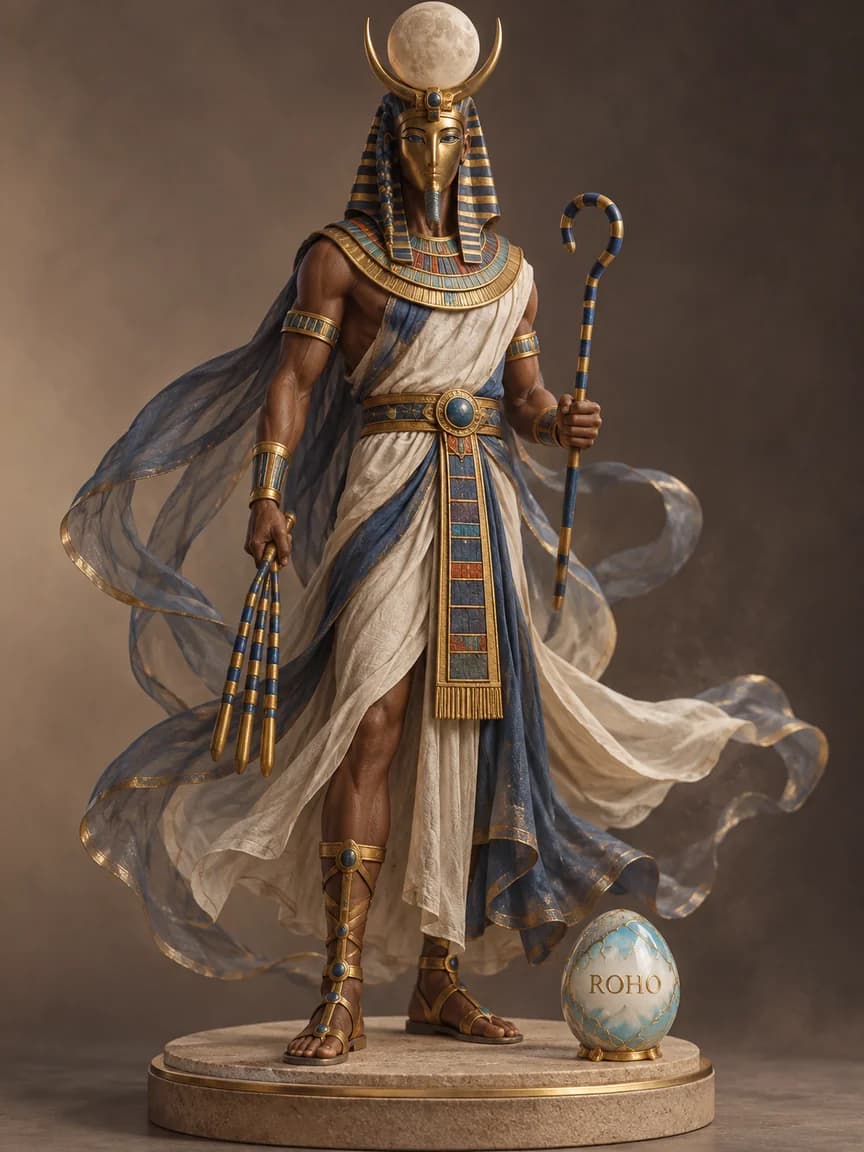
Khonsou
neutralLunar god of Thebes
Khonsu is the lunar god of ancient Egypt, whose name, often linked to the verb to cross, evokes the traveller who journeys across the night sky. At Thebes, he forms the local divine triad as the son of Amun and the goddess Mut. He is most often represented as a young man or a child bearing the sidelock of youth, his body sometimes sheathed like a mummy, crowned with the lunar disc set upon the crescent. He also appears in a falcon-headed form surmounted by the moon. A deity of time and of the lunar phases, Khonsu is also invoked as a healer and protector against evil spirits and diseases. The stele known as the Bakhtan stele tells how his statue, sent under Ramesses II, is said to have delivered a foreign princess possessed by a demon. His great temple stands within the enclosure of Karnak, at the heart of the domain of Amun. Under the name of Khonsu the Counsellor or Khonsu who governs, he is venerated for his oracular and medical powers. Associated with the reckoning of time, he shares certain traits with Thoth, another lunar deity of the Egyptian pantheon.
Era
3,000 to 30 BCE
Frequently asked questions
Of what is Khonsu the god?
Of the moon and its cycle. A deity of nocturnal time, he is also invoked as a healer and protector against malevolent spirits and diseases.
What is his place in the triad of Thebes?
He is its son, alongside his father Amun and his mother Mut. This Theban triad structured the cult of the great domain of Amun at Karnak.
What does the Bakhtan stele tell?
This text relates how a statue of Khonsu, sent under Ramesses II, is said to have healed a foreign princess possessed by a demon, illustrating the god's healing and oracular reputation.
Related spirits
Further reading
Sources and references
- Richard H. Wilkinson, The Complete Gods and Goddesses of Ancient Egypt (2003)
- Claude Traunecker, Les dieux de l'Égypte (2001)
- , Wikipedia (FR/EN)