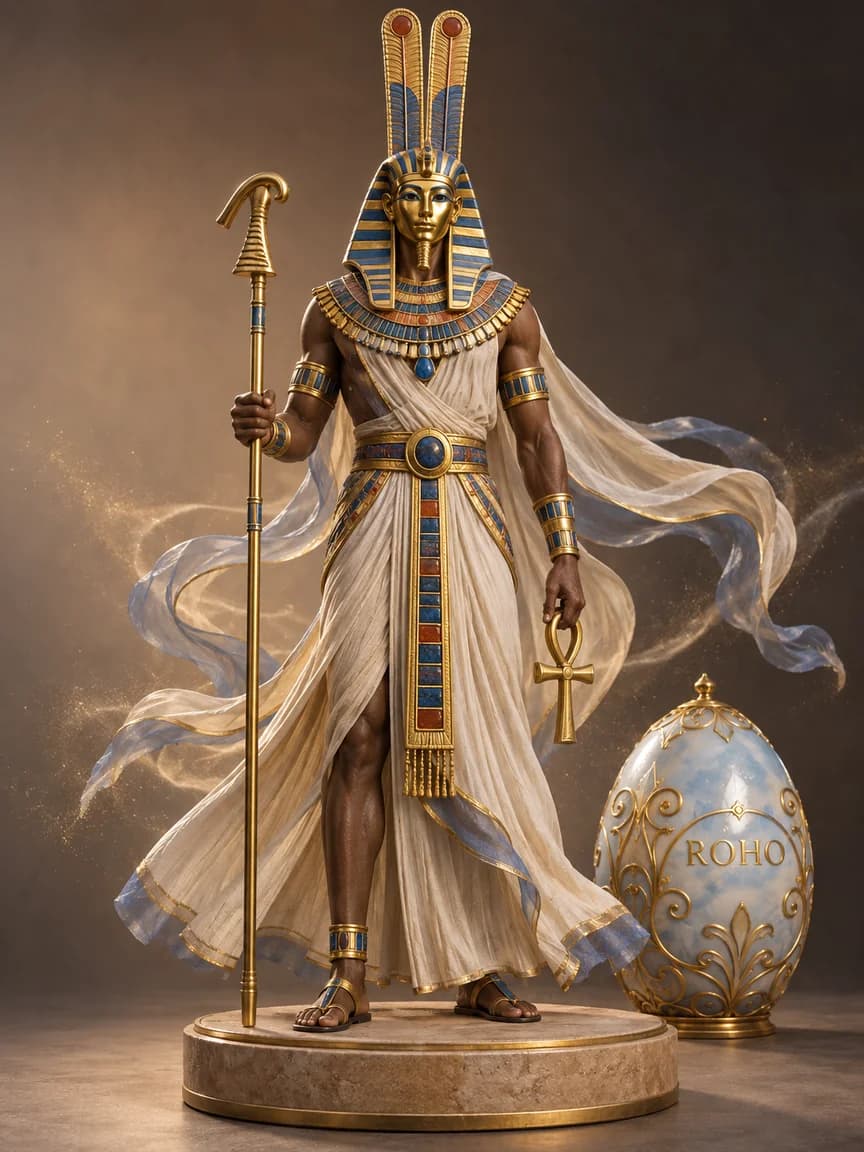
Amon
neutralHidden god, king of the gods of Thebes
Amun is a major god of ancient Egypt whose name, Imen, means the Hidden or the Invisible, underlining a mysterious and elusive nature, associated with breath and wind. At first a local deity of Thebes and a member of the Ogdoad of Hermopolis, he knows a remarkable ascent. In the New Kingdom, after the expulsion of the Hyksos, he becomes the national god, king of the gods, credited with Egypt's victories. He then unites with the solar god Ra to form Amun-Ra, a cosmic and universal deity. He is represented as a man wearing a crown with tall plumes, his skin often blue evoking the celestial vault, or in the guise of a ram with curved horns, his sacred animal, as well as the goose. At Thebes, he forms with the goddess Mut and the lunar god Khonsu the Theban triad. His immense temple of Karnak counted among the richest in the land, linked to Luxor by avenues of ram-headed sphinxes. His oracle of the Siwa oasis acquired a renown that reached the Greek world.
Era
3,000 to 30 BCE
Frequently asked questions
What does the name of Amun mean?
The name Imen means the Hidden or the Invisible, expressing the idea of a god whose true nature escapes perception, often associated with breath and wind.
What is Amun-Ra?
It is the fusion of Amun, god of Thebes, with Ra, the solar god of Heliopolis. This union made Amun-Ra the supreme and universal deity of the Egyptian New Kingdom.
Where was Amun venerated?
His cult radiated from Thebes, around the great temples of Karnak and Luxor, but also as far as Nubia and the Siwa oasis, where his oracle was renowned.
Related spirits
Further reading
Sources and references
- Richard H. Wilkinson, The Complete Gods and Goddesses of Ancient Egypt (2003)
- Claude Traunecker, Les Dieux de l'Égypte (2001)
- , Wikipedia (FR/EN)