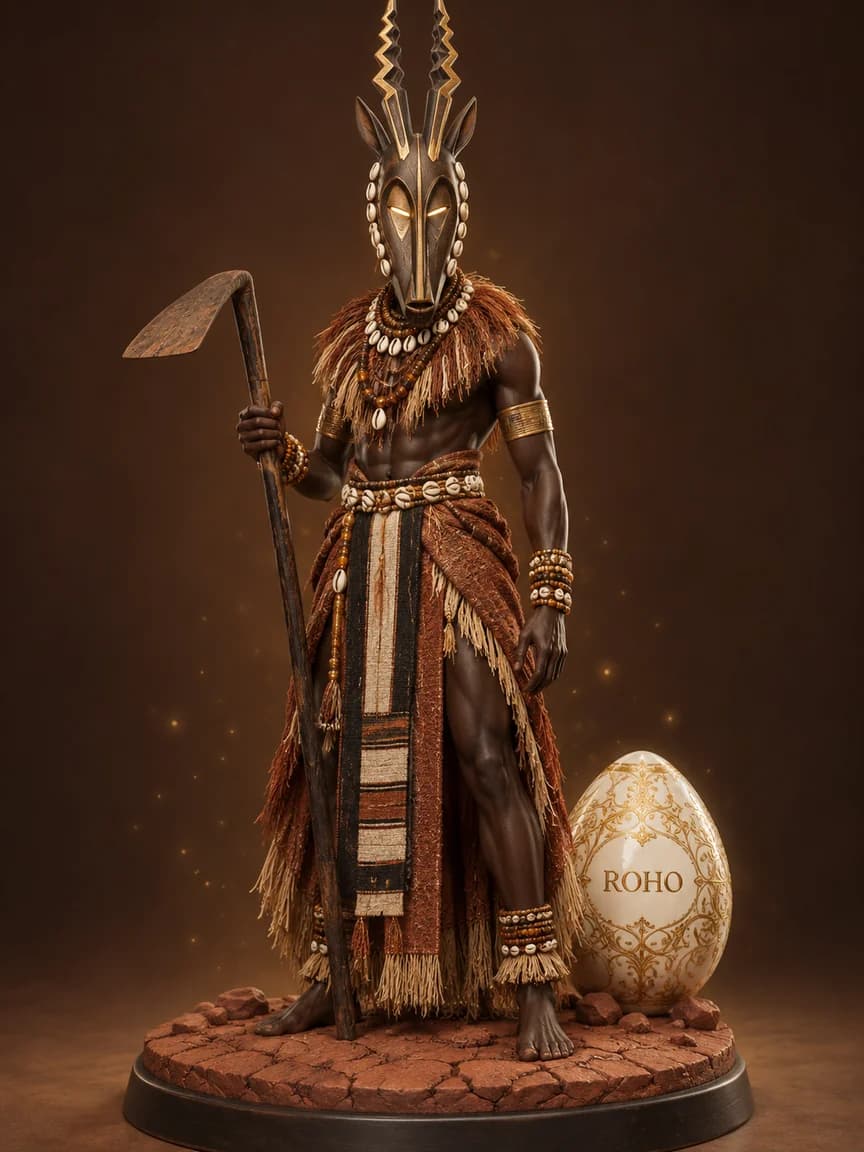
Chiwara (ci Wara)
allyAgriculture, labour
Chiwara belongs to the agrarian cycle of Bambara thought. The myth, of which several versions have been collected, makes him a being of primordial times, often presented as the son of old Musokoroni: half man, half antelope, he dug the earth with his claws and his staff and taught humans to cultivate millet. Faced with the negligence of men, who wasted the grain, he sank into the ground; to honour his memory, the farmers carved the crest-masks that bear his name. The initiation society dedicated to him, the chiwara ton, counts among the six great Bambara initiation societies described by Dominique Zahan, with the ndomo, the komo, the nama, the kono and the korè; it is the only one to join men and women together, just as working the fields demands both sexes. At the festivals of sowing, of harvest and at farming contests, two dancers bent over staffs, their bodies covered in fibres, wear the crests fixed on basketry caps: the male with the openwork mane precedes the female carrying her fawn, while the women sing the praises of the best farmers, themselves honoured with the title of chiwara. Become a national emblem in Mali and a major piece in collections of African art, the chiwara crest remains the symbol of the accomplished farmer.
Powers & Attributes
Role in the ROHO universe
A fragment of Onionkupón's Breath, bound to one of the five elements of the cosmic balance.
Sacred Mask
A mask carved of ancient energy: a symbol of the cosmic force proper to its pantheon.
Era
3,000 to 1,000 BCE: Cycle of Elemental Powers
Spiritual Lesson
To understand the nature of one's own balance and the wisdom hidden behind every trial.
Words of the Spirit
“The spirit crosses what the body cannot.”
Frequently asked questions
Who is Chiwara among the Bambara?
Chiwara, also written Ciwara or Tyiwara, is a mythic spirit of the Bambara of Mali, a being half human, half antelope, who taught agriculture to the first men. His name also designates the famous carved antelope crest-masks, danced at the agrarian rites by the initiation society that keeps his memory.
What do the chiwara crests represent?
The chiwara crests figure a stylised antelope, often the roan antelope, carved in wood and fixed on a basketry cap. They always dance in pairs: the male with the openwork mane and the female carrying her fawn on her back, an image of fecundity. Dominique Zahan distinguishes regional styles: vertical toward Ségou, horizontal toward Bamako, composite in the Bougouni region.
What role does the chiwara ton society play?
The chiwara ton initiates young farmers into agricultural techniques and the values of labour. The only great Bambara initiation society open to both sexes, it organises farming contests in which the best worker receives the title of chiwara. Its dances, at sowing and at harvest, call down the fertility of the fields by symbolically uniting sun, earth and water.
Related spirits
Further reading
Sources and references
- Dominique Zahan, Antilopes du soleil : arts et rites agraires d'Afrique noire (1980)
- Dominique Zahan, Sociétés d'initiation bambara : le Ndomo, le Korè (1960)
- Germaine Dieterlen, Essai sur la religion bambara (1951)
- Viviana Pâques, Les Bambara (1954)