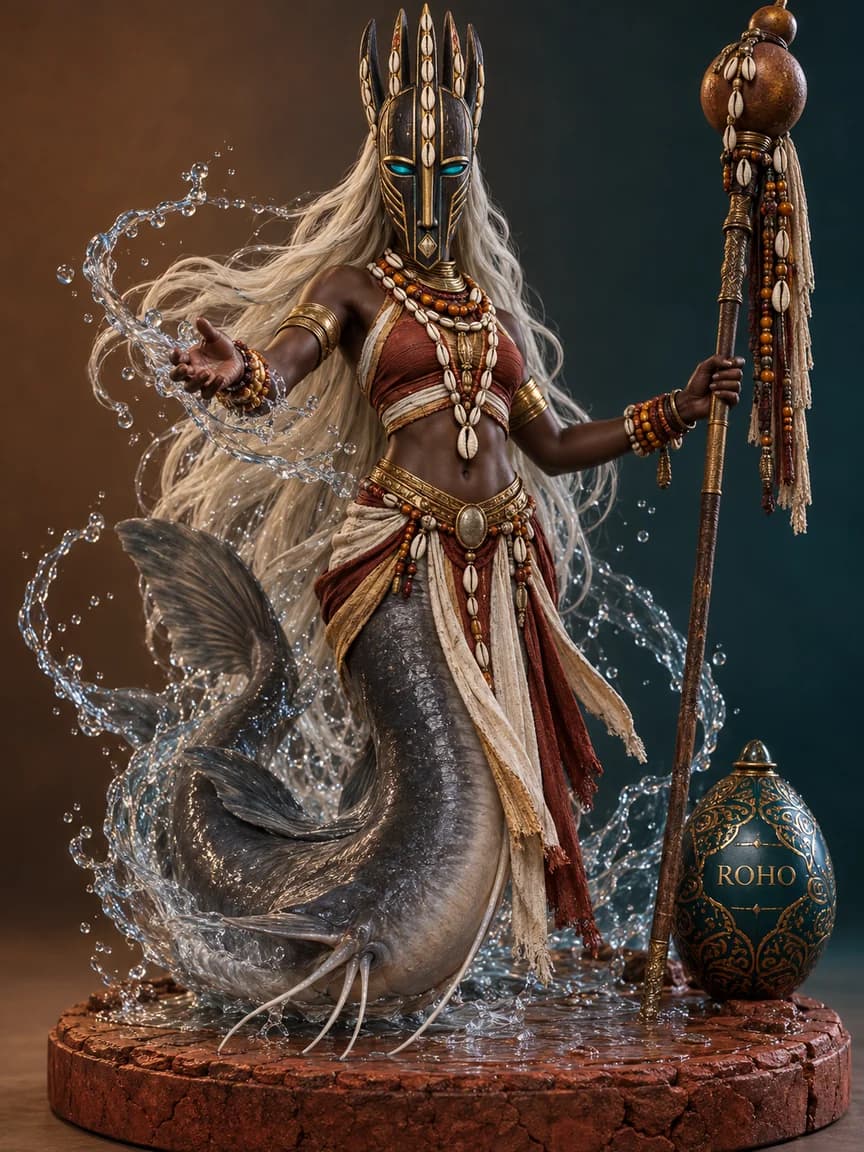
Faro
allyWater, speech, order
In the cosmogonic narratives collected in Mali by French ethnographers, Faro intervenes after the initial creation, when the work of Pemba and the wanderings of Musokoroni have introduced disorder and death. Descending from the sky with the rainwater, he purifies the earth, classifies beings and things, sets the prohibitions and reveals articulate speech to humans, of which he remains the master. Androgynous, often figured as a being half human, half aquatic, he dwells in the fresh waters and is identified with the Niger River, whose course traces his mythic body: his head rests at Lake Débo, his right arm forms the Bani River. Guarantor of the fecundity of fields and births alike, he sends the beneficent rain from the seventh heaven and watches over the floods that regenerate the land each year. His cult unfolds in sanctuaries established along the river, the faro tyn, where communities leave offerings and libations before fishing, navigation or sowing. At Kangaba, the sanctuary of the Kamabolon, ritually restored every seven years, preserves wall paintings that symbolically transcribe the essential beings and elements of the world. Twins and certain aquatic species are ritually associated with him, signs of his double nature and of his sovereignty over the waters.
Powers & Attributes
Role in the ROHO universe
A fragment of Onionkupón's Breath, bound to one of the five elements of the cosmic balance.
Sacred Mask
A mask carved of ancient energy: a symbol of the cosmic force proper to its pantheon.
Era
3,000 to 1,000 BCE: Cycle of Elemental Powers
Spiritual Lesson
To understand the nature of one's own balance and the wisdom hidden behind every trial.
Words of the Spirit
“The waters keep the memory of what the earth forgets.”
Frequently asked questions
Who is Faro in Bambara religion?
Faro, sometimes written Fâro, is the great deity of the waters in the traditional religion of the Bambara of Mali. An androgynous spirit bound to the Niger River, master of the Word and of rain, he reorganises and purifies the world after the creation troubled by Pemba, then passes on to humans speech, the laws and the first seeds.
What is the link between Faro and the Niger River?
Tradition identifies Faro's mythic body with the course of the Niger River: his head rests at Lake Débo and his right arm forms the Bani River. Sanctuaries, the faro tyn, line the banks, where communities leave offerings and libations. The annual floods, which make the fields fertile, are understood as the regular manifestation of his regenerating power.
Why is Faro called master of the Word?
In the cosmogony collected by Germaine Dieterlen, Faro reveals articulate speech to humans during the reorganisation of the world, after the disorder introduced by Pemba's creation. With it he passes on the laws, the prohibitions and the classifications that order society. To speak justly is thus to carry on his work: silence and speech both fall under his authority.
Related spirits
Further reading
Sources and references
- Germaine Dieterlen, Essai sur la religion bambara (1951)
- Solange de Ganay, Notes sur la théodicée bambara (1949)
- Viviana Pâques, Les Bambara (1954)