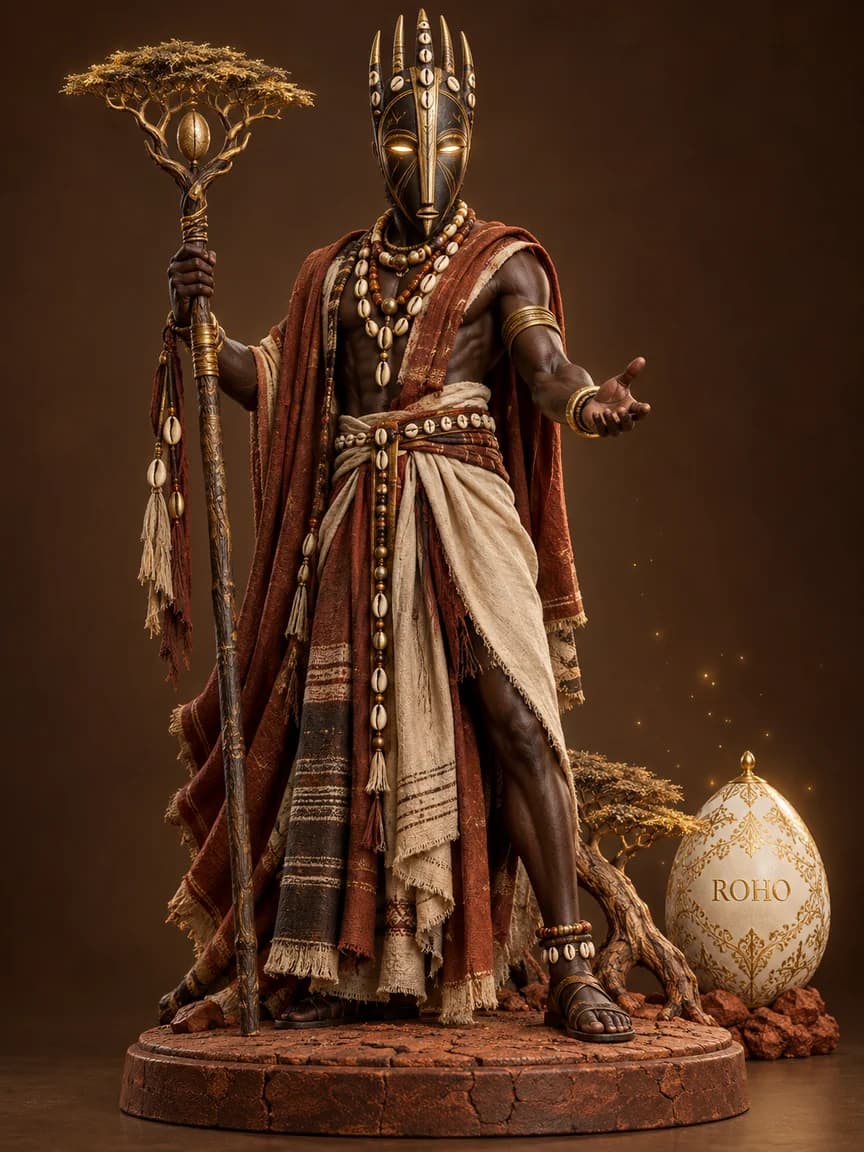
Pemba
allyGod
Pemba holds, with Faro, the centre of the Bambara creation narratives, whose versions collected by Germaine Dieterlen, Solange de Ganay and Viviana Pâques differ on many points: he appears there sometimes as the first demiurge, sometimes as one of the aspects of a composite creator called Bemba or Ngala. In the most widespread narrative, Pemba descends from the sky in the form of a seed and becomes the balanza, the bare acacia of the Sudanese savanna. From his wood is born Musokoroni, the first feminine creature, who plants her creator in the earth, propagates vegetation, then sows disorder and suffering in the world. Master of the soil and the trees, Pemba at first receives the exclusive cult of humans: they circled his trunk and offered him their devotion in exchange for his benefactions. But Faro, master of the waters and of the Word, contests his hegemony, redeems the faults committed and becomes the principal benevolent deity of humanity, relegating the cult of the balanza to the rank of mythical memory. The altar called pèmbélé, studied by Solange de Ganay, condenses this theology: a representation of the universe and its creator, it recalls the work of Pemba and the transformation of the four elements that grounds the Bambara cosmogony.
Powers & Attributes
Role in the ROHO universe
Founding presence. PEMBA stands at the root of the world and sustains the weave since before the beginning. Bound to the Bambara pantheon.
Sacred Mask
An ancient ritual mask of sacred wood, old metal and black stone, engraved with symbols of creation, embodiment of the power of Pemba
Era
Ancient cycle
Frequently asked questions
Who is Pemba in the Bambara cosmogony?
Pemba, also called Bemba or Ngala according to the traditions, is one of the great creator principles of the Bambara cosmogony of Mali. Descended from the sky in the form of a seed, he becomes the balanza, the acacia from which he draws the first woman, Musokoroni, before Faro comes to reorder the world.
What link unites Pemba to the balanza tree?
According to the myth, Pemba falls from the sky in the form of an acacia seed and becomes the balanza, the characteristic tree of the Sudanese savanna. From his wood is born Musokoroni, the first feminine creature. Humans long venerated this tree, the centre of the first cult, before Faro contested his hegemony and became the principal benevolent deity of humanity.
What is the pèmbélé?
The pèmbélé is a ritual altar studied by Solange de Ganay in her Notes sur la théodicée bambara. A condensed representation of the universe, it figures at once the creator, the earth and the organisation of the cosmos, and serves as a support for the rites that recall Pemba's creative work and the transformation of the four elements.
Related spirits
Further reading
Sources and references
- Germaine Dieterlen, Essai sur la religion bambara (1951)
- Solange de Ganay, Notes sur la théodicée bambara (1949)
- Viviana Pâques, Les Bambara (1954)