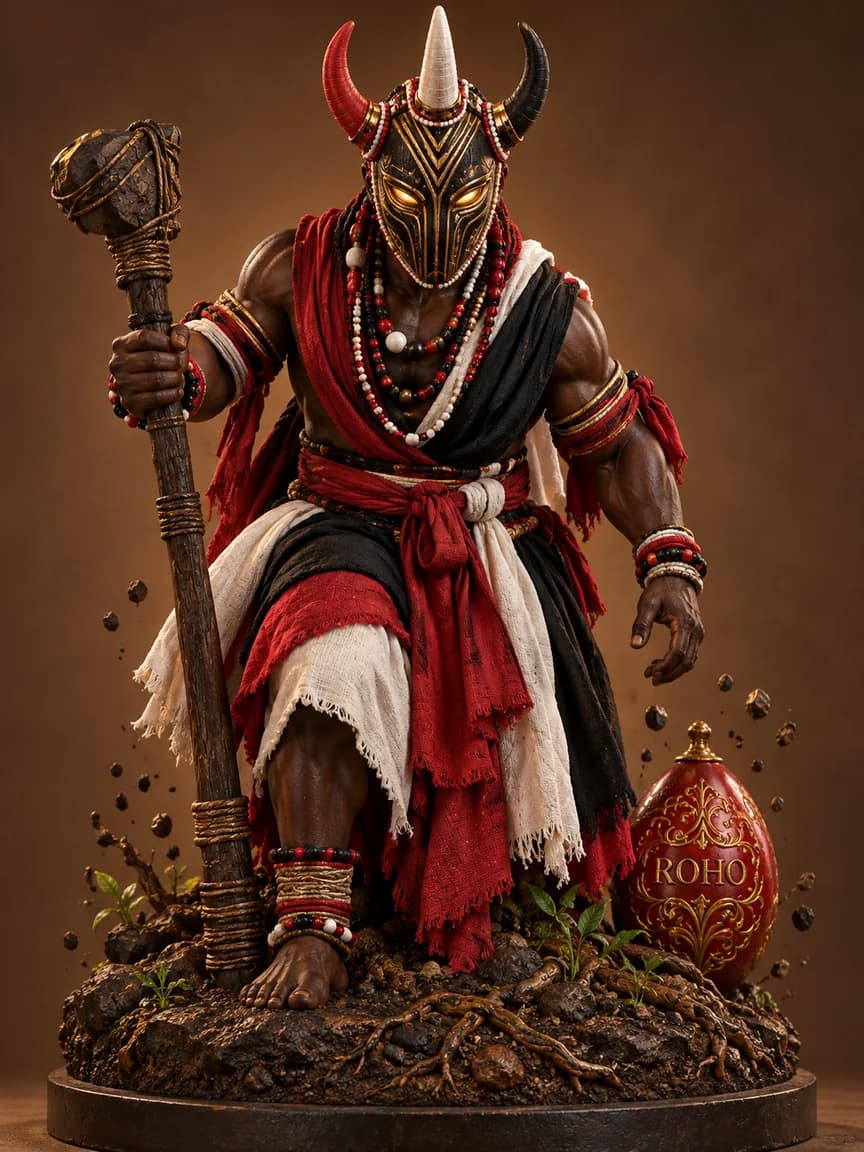
Bossou Twa Kòn
neutralBull, raw strength, fertility
Bossou Twa Kòn, Bossou of the three horns, is the bull lwa of Haitian Vodou. Served in the Petro rite, he embodies strength in its raw state, the kind that charges without negotiating, and the fertility that goes with animal power. His three horns set him apart from any ordinary bovine and signal the supernatural being. His name ties Haitian practice to Dahomey, where Bosu belongs to the pantheon and where the name was borne by the royalty of Abomey: like Agassou, he is one of the lwa through whom the memory of the Bight of Benin crossed the Atlantic. His servants describe him as impetuous and hard to contain once he has mounted someone, and the ceremonies concerning him call for experienced officiants. His colours are red, black and white. He is granted a clear use: when strength is needed rather than finesse, he is the one who is called. This very specialisation makes him a lwa who is not called upon lightly.
Powers & Attributes
Role in the ROHO universe
Bound to one of the five elements of the cosmic balance. Its power springs from the energy proper to its tradition, and from no other.
Sacred Mask
A mask carved of ancient energy, a symbol of the cosmic force proper to its pantheon.
Era
1500 to 1900: Cycle of the Rebels
Words of the Spirit
“Strength that does not know its measure ends up overturning what it protects.”
Frequently asked questions
Who is Bossou in Haitian Vodou?
Bossou Twa Kòn is the bull lwa, served in the Petro rite. His three horns signal the supernatural being. He embodies strength in its raw state and fertility, and he is called when power is needed rather than finesse.
Where does the name Bossou come from?
From Dahomey, present-day Benin, where Bosu belongs to the pantheon and where the name was borne by the royalty of Abomey. Like Agassou, Bossou is one of the lwa through whom the memory of the Bight of Benin crossed the Atlantic.
Related spirits
Further reading
Sources and references
- Alfred Métraux, Le Vaudou haïtien (1958)
- Leslie G. Desmangles, The Faces of the Gods: Vodou and Roman Catholicism in Haiti (1992)
- Laënnec Hurbon, Les Mystères du vaudou (1993)
- Anne M. Platoff, Drapo Vodou: Sacred Standards of Haitian Vodou (Flag Research Quarterly, n° 7, North American Vexillological Association, 2015), p. 4