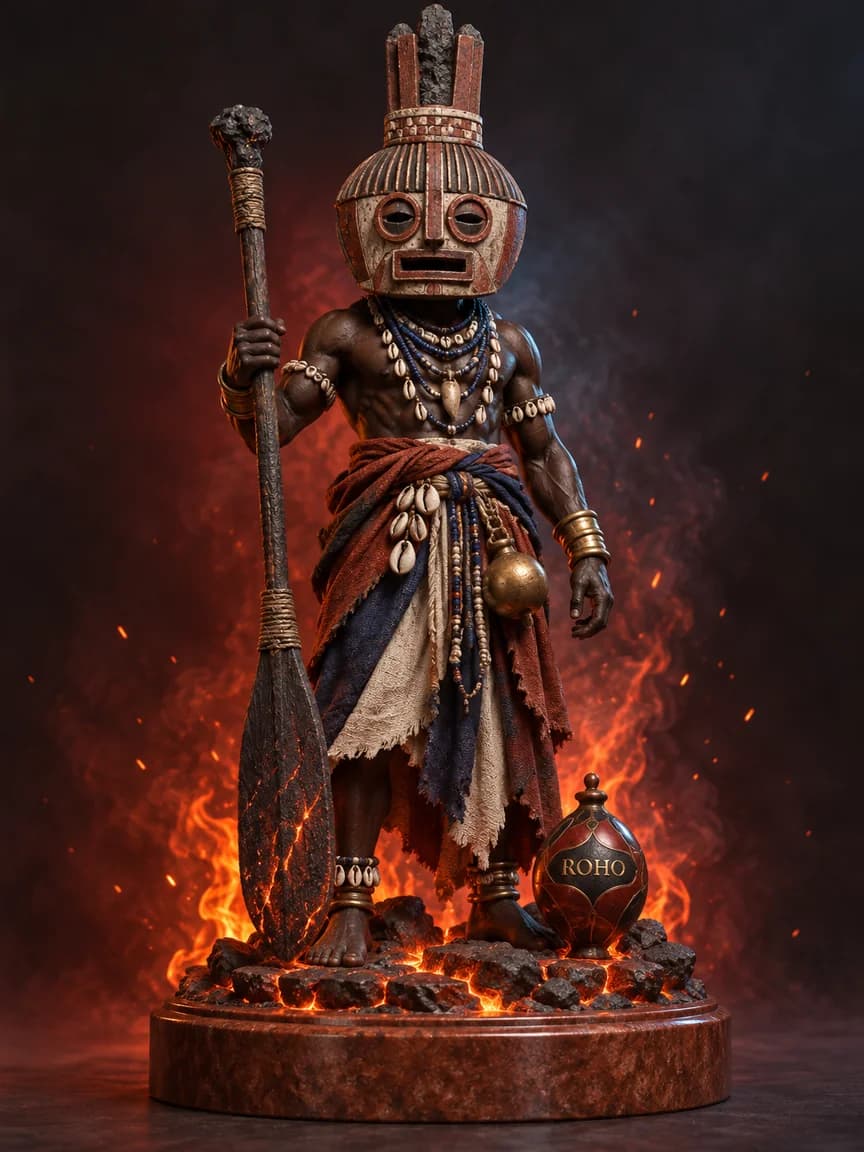
Aganju
neutralOrisha of fire and volcanoes
Aganju, also Aganjú, Agayú or Aggayú, is an orisha of the Yoruba religion and its Afro-diasporic prolongations. He is associated with the sun, fire, the wild earth and, in the Cuban tradition, with volcanoes, an image of his ardent temperament. To him are also attached the desert, the high mountains and the crossing of rivers, where he is sometimes invoked as a ferryman. Yoruba geography knows no active volcanoes, so this association developed above all in the Americas as a metaphor of his explosive power. Aganju is closely bound to Sango, the god of thunder: the oral traditions make him sometimes his nephew, sometimes his father or his brother, and the history of Oyo presents an Aganju among the legendary Alaafin, son of Ajaka. In Brazil, he is sometimes called Xangô menino, the young Sango, the embodiment of an igneous, vigorous energy. In Santería, he is syncretised with Saint Christopher. His force manifests itself through the sword, heat and fire.
Era
Yoruba traditions, West Africa
Frequently asked questions
Of what is Aganju the orisha?
Aganju is the orisha of fire, the sun and the wild earth. The Afro-diasporic traditions associate with him volcanoes and the burning heart of the earth, symbols of his indomitable force.
What is the link between Aganju and Sango?
Aganju and Sango are closely bound. According to the narratives, Aganju is the nephew, the father or the brother of Sango, and both belong to the royal lineage of Oyo. In Brazil, he is called Xangô menino.
Why is Aganju associated with volcanoes?
Yorubaland counts no active volcanoes. This image developed in the Americas, notably in Cuba, as a metaphor of Aganju's explosive temperament and of his bond with subterranean heat.
Related spirits
Further reading
Sources and references
- Baba Ifa Karade, The Handbook of Yoruba Religious Concepts (1994)
- Pierre Fatumbi Verger, Orixás: Deuses Iorubás na África e no Novo Mundo (1981)
- , Wikipedia (FR/EN)