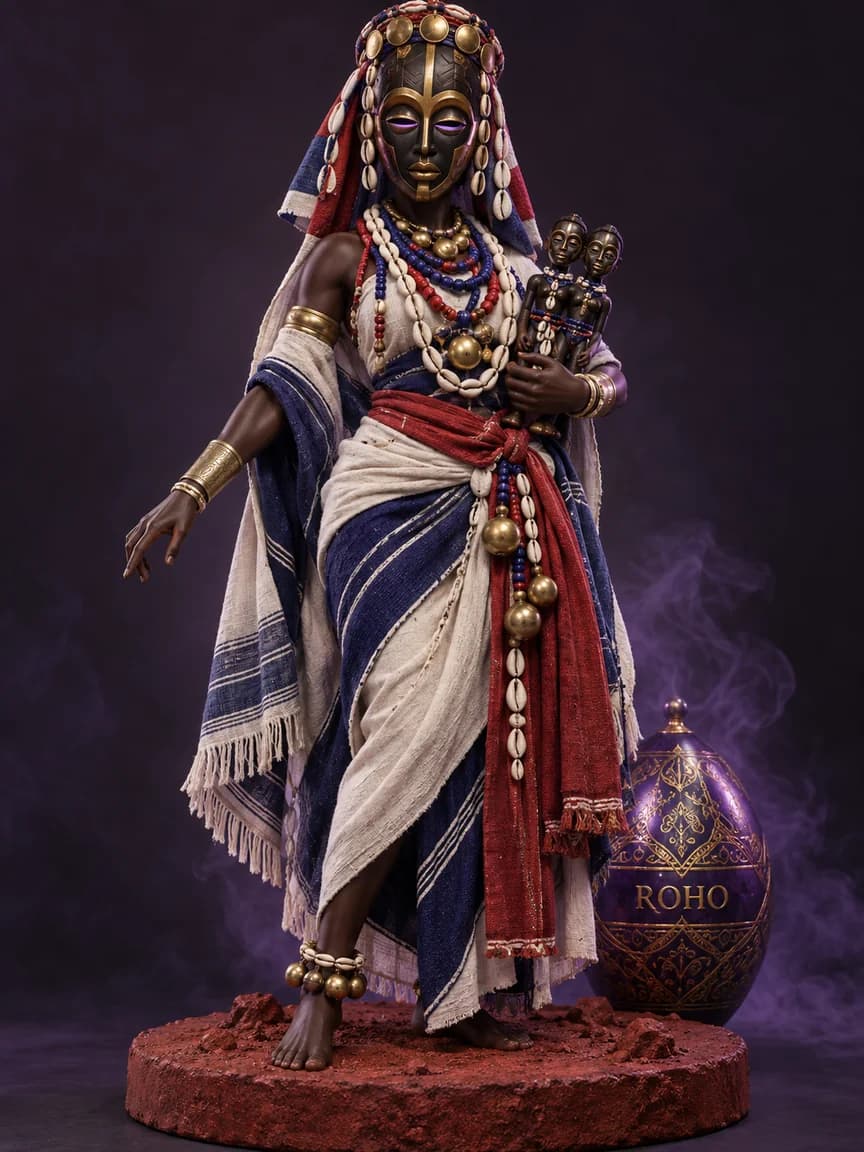
Zinsu
allyGoddess
Zinsu is, with her twin Zinsi, one of the two figures of a cycle of narratives of Dahomean folklore, among the Fon and Ewe peoples of present-day Benin, Togo and eastern Ghana. Tradition presents them as twins endowed with great supernatural powers, renowned above all for their feats of magic. The available sources remain limited and imprecise. They fix neither their gender nor their exact status, between mortal heroes and supernatural beings, and the couple Zinsu and Zinsi appears more as a pair of tale magicians than as deities of the vodun pantheon properly speaking. Their cycle belongs to a context in which twinship carries a strong sacred charge. Among the Fon and the Ewe, twins, hohovi, are the object of an ancient cult and of particular rites, and the ethnologist Melville Herskovits collected and analysed many of these narratives. The academic documentation bearing specifically on Zinsu and Zinsi nevertheless remains rare, which invites caution as to the details of this figure.
Powers & Attributes
Role in the ROHO universe
Weaver of the invisible threads. ZINSU handles the subtle energies and teaches the language of correspondences. Bound to the Fon/Eʋe pantheon.
Sacred Mask
An ancient ritual mask of vegetable ivory, amethyst and sacred wood, engraved with symbols of witchcraft, embodiment of the power of Zinsu
Era
Ancient cycle
Frequently asked questions
Who are Zinsu and Zinsi?
Zinsu and Zinsi are twins of Dahomean folklore, among the Fon and the Ewe of West Africa. The narratives present them as endowed with great supernatural powers and famed for their feats of magic. The old sources specify neither their gender nor whether they are mortals or divine beings.
To which people and which region is Zinsu attached?
Zinsu belongs to the Fon and Ewe traditions, two related peoples settled on the coast and the hinterland of present-day Benin, Togo and eastern Ghana, the former kingdom of Dahomey. These narratives were notably collected by the ethnologist Melville Herskovits in the twentieth century.
Why do twins hold a particular place among the Fon and the Ewe?
In the Fon and Ewe area, the birth of twins carries a strong sacred value and gives rise to an ancient cult as well as specific rites. This importance granted to twinship illuminates the presence of twin figures such as Zinsu and Zinsi in the narrative heritage of the region.
Related spirits
Further reading
Sources and references
- Melville J. et Frances S. Herskovits, Dahomean Narrative: A Cross-Cultural Analysis (1958)
- Melville J. Herskovits, Dahomey: An Ancient West African Kingdom (1938)