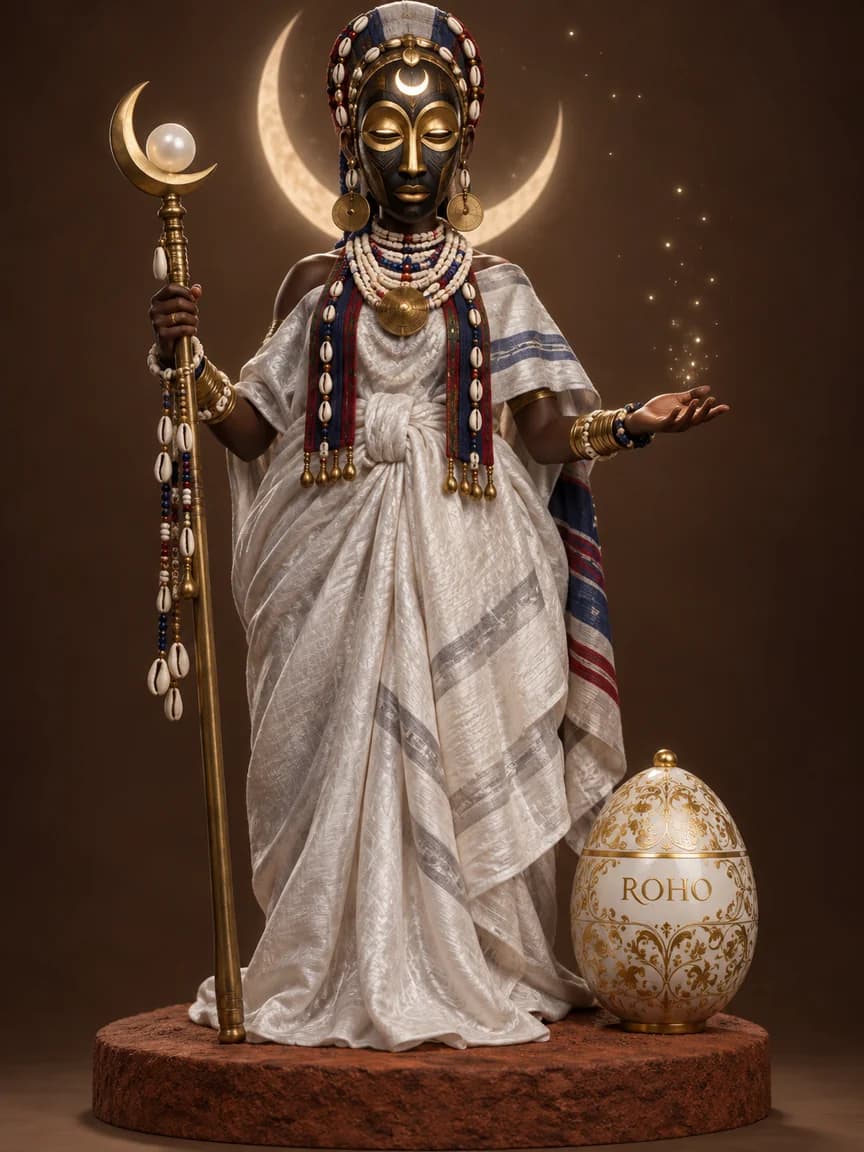
Mawu
allyGoddess
Mawu is the creator deity in the religion of the Ewe and Fon peoples of Togo and Benin. Her name, in the Ewe language, evokes what cannot be surpassed, what stretches above all things. Mawu is associated with the moon, the night, the east, fecundity and motherhood. She forms with Lisa, bound to the sun and the day, a divine couple often named Mawu-Lisa, in which the duality of the feminine and the masculine expresses the balance of the world. According to the Fon, Mawu and Lisa are the children of Nana Buluku, the primordial deity. The narratives attribute to Mawu the creation of human beings shaped in clay, while Lisa is said to have taught men the arts of civilisation. After creating the earth, Mawu is said to have leaned on the cosmic serpent Aido Hwedo to support it. From her lineage descends Gbadu, linked to divination. Historically, the cult of Mawu-Lisa, of partly Yoruba origin, spread westward to become central in the religion of the kingdom of Dahomey. Mawu thus embodies the feminine, lunar source of creation.
Powers & Attributes
Role in the ROHO universe
Founding presence. MAWU stands at the root of the world and sustains the weave since before the beginning. Bound to the Fon/Eʋe pantheon.
Sacred Mask
An ancient ritual mask of sacred wood, old metal and black stone, engraved with symbols of creation, embodiment of the power of Mawu
Era
Ancient cycle
Frequently asked questions
Who is Mawu?
The creator deity of the Ewe and the Fon, associated with the moon and motherhood. She is often invoked with Lisa, bound to the sun, under the name of Mawu-Lisa.
What link unites Mawu and Lisa?
They form a complementary divine couple. Mawu, feminine and lunar, and Lisa, masculine and solar, together embody the duality and the balance at the origin of the world.
Who is Nana Buluku in relation to Mawu?
Among the Fon, Nana Buluku is the primordial deity whose children are Mawu and Lisa. She represents the source from which the creator couple proceeds.
Related spirits
Further reading
Sources and references
- Melville J. Herskovits, Dahomey: An Ancient West African Kingdom, J. J. Augustin, 1938
- Bernard Maupoil, La géomancie à l'ancienne Côte des Esclaves, Institut d'ethnologie, 1943