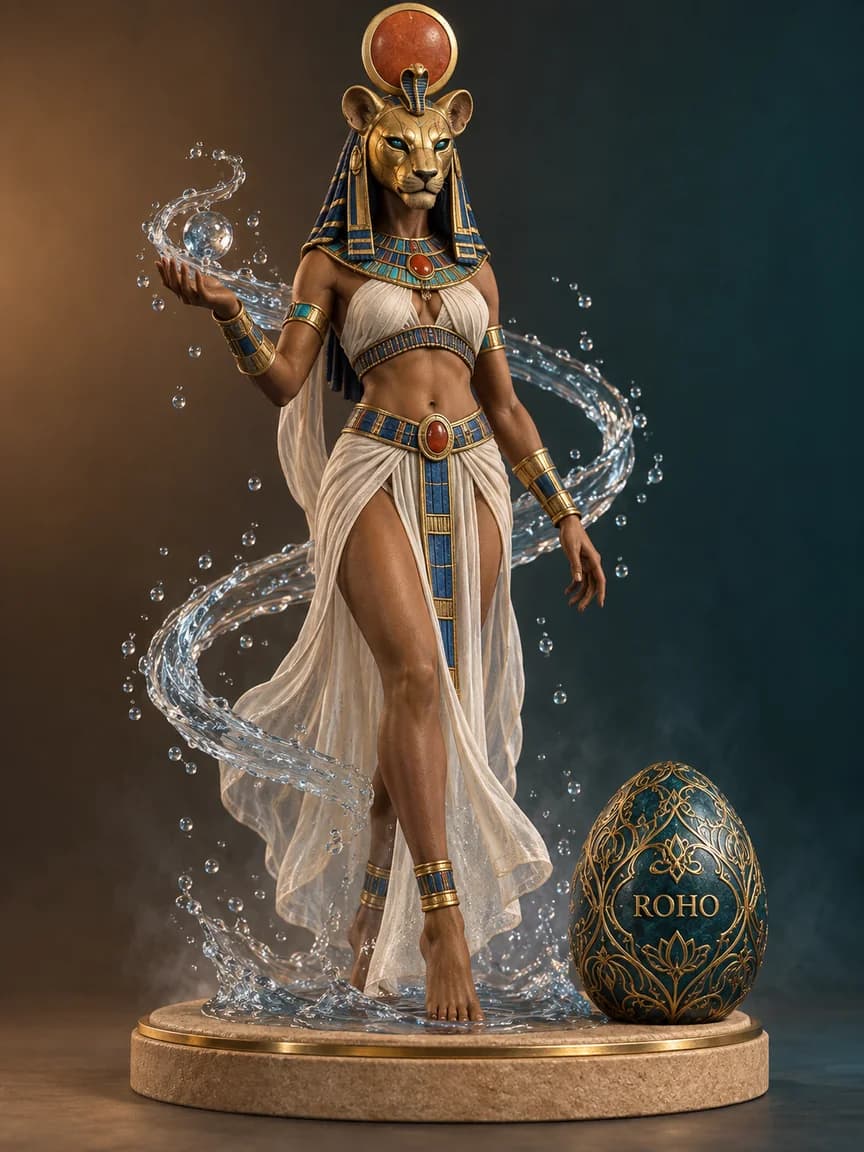
Tefnout
neutralGoddess of Moisture
Tefnut is the goddess of moisture, humid air and dew in the religion of ancient Egypt. A member of the Ennead of Heliopolis, she is engendered by the demiurge Atum at the same time as her twin brother Shu, god of the air. With him she forms the first sexually differentiated divine couple, from whom are born Geb, the earth, and Nut, the sky. Her name is likened to verbs meaning to spit or to moisten, echoing the narratives in which Atum creates the original couple by his spittle or his breath. Tefnut completes the dry air of Shu with the humid element, indispensable to the renewal of life. She is often assimilated to the Eye of Ra, the fearsome, burning form of the solar goddess, and can be likened to Maat or to Sekhmet. In the iconography, she is figured as a woman with a lioness's head surmounted by the solar disc. At Leontopolis, a pair of living lions embodied Tefnut and Shu. Her cult is attested notably at Heliopolis and at Leontopolis.
Era
3,000 to 30 BCE
Frequently asked questions
Of what is Tefnut the goddess?
Tefnut personifies moisture, humid air and dew. She completes the dry air of her twin Shu and represents the humid element necessary to the renewal of life.
Why is Tefnut represented as a lioness?
Her fearsome character brings her close to the lioness goddesses and to the Eye of Ra. She is figured as a woman with a lioness's head crowned with the solar disc, and at Leontopolis a living lioness embodied her alongside a lion for Shu.
What is Tefnut's place in the Ennead?
Engendered by Atum with her brother Shu, Tefnut belongs to the first divine generation. From their couple are born Geb, the earth, and Nut, the sky, ancestors of Osiris and Isis.
Related spirits
Further reading
Sources and references
- Richard H. Wilkinson, The Complete Gods and Goddesses of Ancient Egypt (2003)
- Erik Hornung, Les dieux de l'Égypte: l'un et le multiple (1986)
- , Wikipedia (FR/EN)