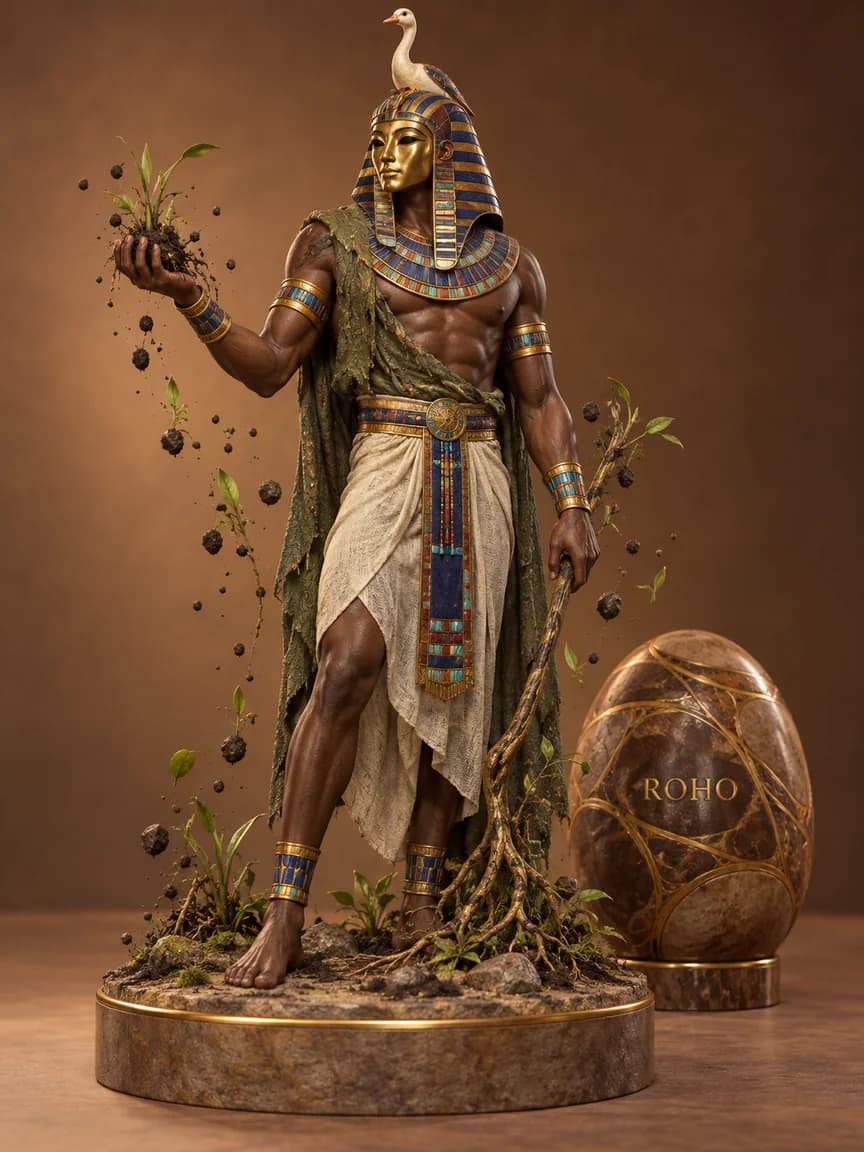
Geb
neutralGod of the Earth
Geb is the god of the earth in the religion of ancient Egypt. A member of the Ennead of Heliopolis, he is the son of Shu, god of the air, and of Tefnut, goddess of moisture. He forms with his sister Nut, the personification of the sky, an original couple whom their father Shu separates by supporting the celestial vault above the earth. Geb embodies the soil, minerals and vegetation, and he passes for responsible for the fertility of the fields as for earthquakes. The Heliopolitan tradition makes him the father of Osiris, Isis, Seth and Nephthys, and presents him as the first mythical king of Egypt, so that the royal throne is sometimes called the throne of Geb. In the iconography, he is figured as a man lying down, his skin sometimes green or black, the colour of the fertile earth, while Nut arches above him. His emblematic animal is the goose, which enters into the writing of his name. His cult is attested above all at Heliopolis.
Era
3,000 to 30 BCE
Frequently asked questions
What is Geb's role in Egyptian mythology?
Geb personifies the earth. He is associated with the fertility of the soil, with vegetation and with earthquakes, and the Heliopolitan tradition makes him the first mythical king of Egypt.
Who are Geb's parents and children?
Geb is the son of Shu and Tefnut. With his sister and wife Nut, he engenders Osiris, Isis, Seth and Nephthys, at the origin of the following generation of the Ennead.
How is Geb represented?
He is most often figured as a man lying beneath the goddess Nut arched as the celestial vault. His skin is sometimes green, the colour of vegetation, and his emblematic animal is the goose.
Related spirits
Further reading
Sources and references
- Richard H. Wilkinson, The Complete Gods and Goddesses of Ancient Egypt (2003)
- Erik Hornung, Les dieux de l'Égypte: l'un et le multiple (1986)
- , Wikipedia (FR/EN)