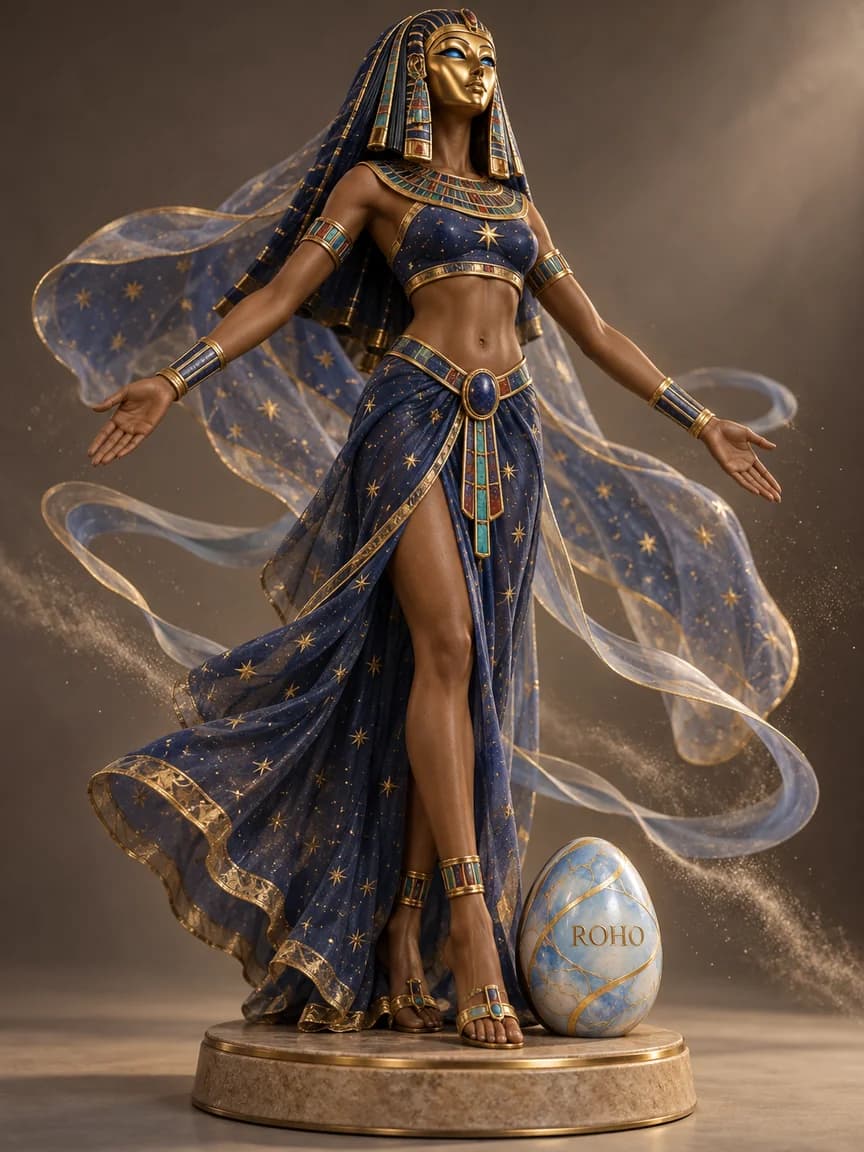
Nout
neutralGoddess of the Sky
Nut is the goddess of the sky in the religion of ancient Egypt. A member of the Ennead of Heliopolis, she is the daughter of Shu and Tefnut, as well as the sister and wife of Geb, god of the earth. She personifies the firmament and passes for the mother of the stars. Each evening, she swallows the sun, which she brings into the world again at dawn, an image of the daily cycle of light. The Heliopolitan tradition makes her the mother of Osiris, Isis, Seth and Nephthys. One narrative reports that she obtained from Thoth five additional days, the epagomenal days, in order to give birth to her children despite the interdict of Ra, which brought the year from three hundred and sixty to three hundred and sixty-five days. In the iconography, Nut is figured as a woman whose body is spangled with stars, arched above the earth and supported by Shu. She also appears in the form of a celestial cow. Often painted inside sarcophagi, she protects the deceased and favours their rebirth.
Era
3,000 to 30 BCE
Frequently asked questions
What does the goddess Nut represent?
Nut personifies the sky and the starry vault. She is considered the mother of the stars and rules the daily cycle of the sun, which she swallows in the evening and brings forth in the morning.
Why is Nut painted inside sarcophagi?
Arched above the deceased as she is above the world, Nut envelops the dead. Her presence on the lids and cases of sarcophagi symbolises maternal protection and the promise of rebirth.
What is the link between Nut and the epagomenal days?
According to a myth, Ra forbade Nut to give birth on any day of the year. Thoth won at play five additional days, outside the calendar of three hundred and sixty days, allowing the birth of Osiris, Isis, Seth and Nephthys.
Related spirits
Further reading
Sources and references
- Richard H. Wilkinson, The Complete Gods and Goddesses of Ancient Egypt (2003)
- Erik Hornung, Les dieux de l'Égypte: l'un et le multiple (1986)
- , Wikipedia (FR/EN)