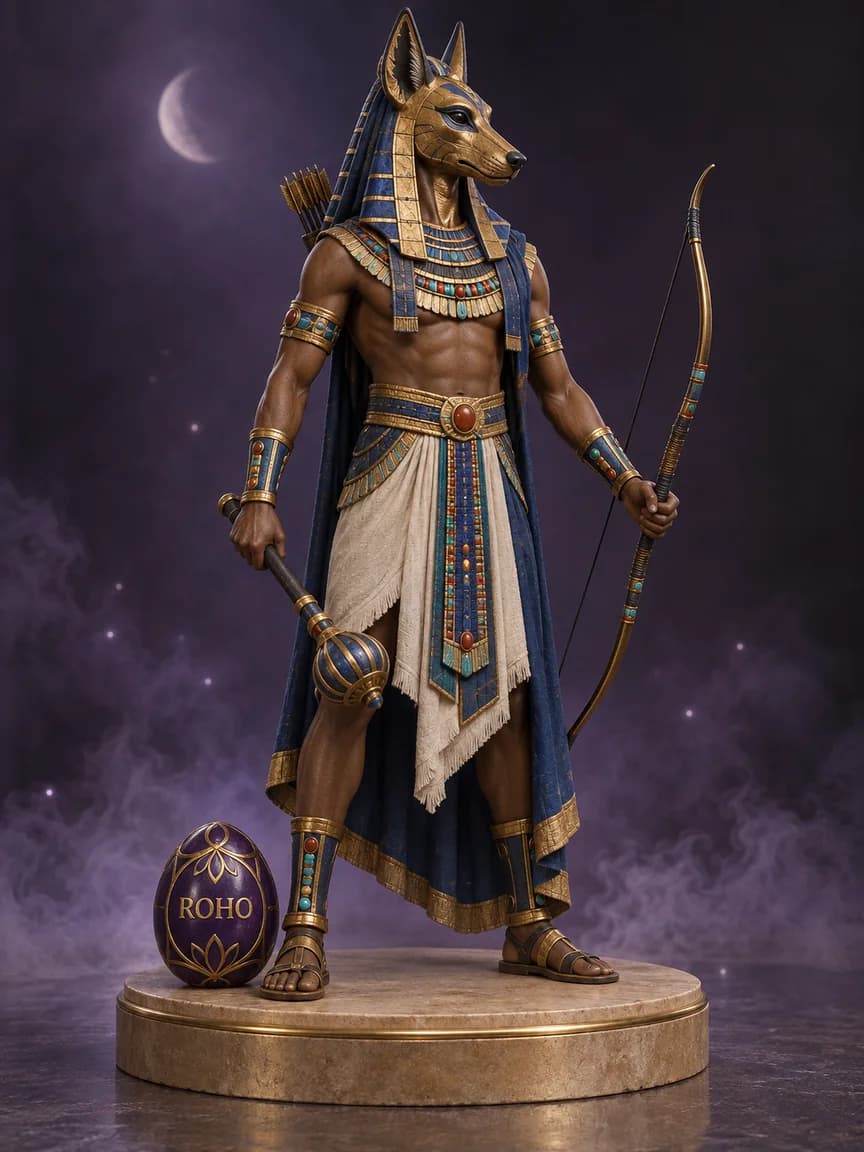
Oupouaout
neutralThe one who opens the ways
Wepwawet, whose name means the one who opens the ways, is an Egyptian god of canine appearance, long identified with a jackal and whom recent studies liken to the wolf. He is distinguished from Anubis by his posture: he stands upright, raised on a standard carried at the head of royal processions, whereas Anubis is most often recumbent. His functions are multiple. Guide of the deceased, he opens and secures the ways leading through the Duat, the underworld. Protector of the pharaoh, he accompanies him to war and at the sed festival, the royal jubilee. His attributes include the mace, the bow and arrows, marks of his warrior role and of his function as scout opening the road for the armies. His principal sanctuary was at Asyut, in Middle Egypt, a city the Greeks named Lycopolis, the city of the wolf. A tomb of this site, called Salakhana, has yielded several hundred votive stelae dedicated to him. Long distinct from Anubis, he ended by being associated with him, to the point of being considered his brother on account of their common funerary functions. He also figures at the prow of the barque of Ra.
Era
3,000 to 30 BCE
Frequently asked questions
What does the name Wepwawet mean?
It means the one who opens the ways. This name refers to his function as scout opening the road for the armies and as guide tracing the ways of the deceased in the beyond.
How does one distinguish Wepwawet from Anubis?
Both gods have a canine appearance, but Wepwawet is represented standing, raised on a standard, whereas Anubis is most often figured recumbent. They were later associated as brothers.
Where was Wepwawet principally venerated?
At Asyut, in Middle Egypt, which the Greeks called Lycopolis, the city of the wolf. The site has yielded hundreds of votive stelae dedicated to the god.
Related spirits
Further reading
Sources and references
- Richard H. Wilkinson, The Complete Gods and Goddesses of Ancient Egypt (2003)
- George Hart, The Routledge Dictionary of Egyptian Gods and Goddesses (2005)
- , Wikipedia (FR/EN)