Orishanla
allyGod
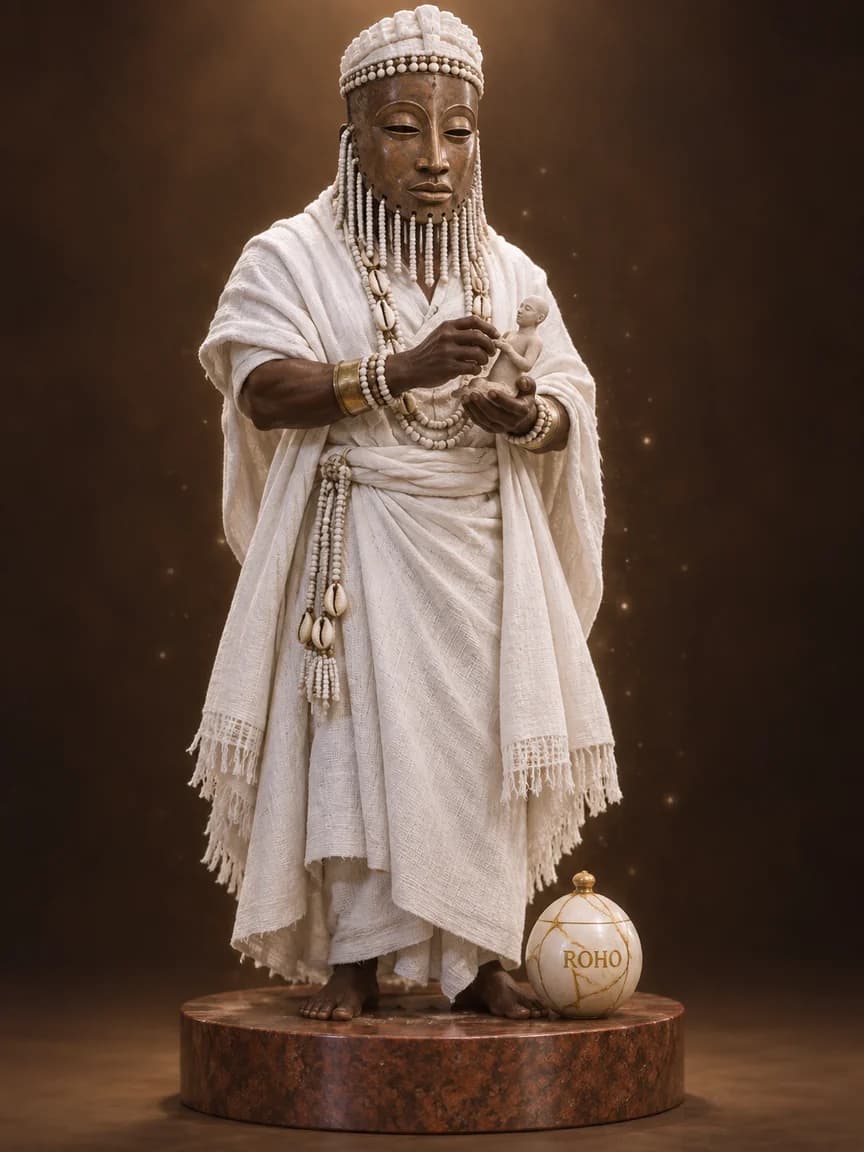
Orishanla, literally the great orisha, is one of the names of Obatala, considered the king or the chief of all the orishas in the Yoruba religion. A deity of creation, purity and wisdom, he is associated with the colour white and with the white cloth from which his name derives. According to tradition, Olodumare, the supreme Being, entrusts to him the creation of the earth, a task that his younger brother Oduduwa finally completes. Obatala then receives the mission of shaping human beings from clay, which earns him the title of sculptor of humanity and father of men. It is said that he models each child in the mother's womb. His principal centre of cult is Ile-Ife, the sacred city of the Yoruba, but his devotion extends to the Americas through Santería and Candomblé, where he is syncretised with Christian figures. He is honoured with white, with ritual cleanliness and with dietary interdicts bound to purity.
Powers & Attributes
Role in the ROHO universe
Voice of its pantheon. ORISHANLA carries the memory of its tradition and weaves a thread into the Mabioni. Bound to the Yoruba pantheon.
Sacred Mask
An ancient ritual mask of sacred wood, old metal and black stone, engraved with symbols of first god, embodiment of the power of Orishanla
Era
Ancient cycle
Frequently asked questions
Is Orishanla the same as Obatala?
Yes. Orishanla, which means the great orisha, is another name of Obatala, considered the king or the chief of all the orishas in the Yoruba tradition.
What is his role in creation?
Charged by Olodumare with creating the earth, he leaves Oduduwa to complete this task, then shapes human beings from clay and models each child in the mother's womb.
How is he venerated?
His cult, centred on Ile-Ife, favours the colour white, ritual cleanliness and interdicts bound to purity. He is also honoured in Santería and Candomblé.
Related spirits
Further reading
Sources and references
- E. Bolaji Idowu, Olodumare: God in Yoruba Belief, 1962
- Pierre Verger, Notes sur le culte des Orisa et Vodun à Bahia, la Baie de Tous les Saints, au Brésil et à l'ancienne Côte des Esclaves en Afrique, Mémoires de l'IFAN n° 51, Dakar (1957)
- William Bascom, The Yoruba of Southwestern Nigeria (1969)