Mbale
allyGod
Mbale holds a singular place in the sacred geography of the Baganda as the hill of war bound to the lubaale Kibuka. It is on this height of the county of Mawokota, in the present-day district of Mpigi near Mpigi Town and Lake Victoria, that tradition situates the fall and the burial of Kibuka, mortally wounded during the war against Bunyoro under the reign of king Nakibinge. The place of his death became the place of his divinisation: the sovereign had the national temple of the god of war erected there, and the sanctuary of Mbale imposed itself as a major centre of the cult of the balubaale. This association is so strong that Kibuka bears the title of Kibuuka Omumbaale, literally Kibuka of Mbale, which binds the god inseparably to his hill. The temple consisted of a great conical hut capped with a tall thatched roof, surrounded by a reed enclosure marking out a sacred courtyard subject to ritual interdicts. The site was served by priests and guardians charged with the relics and the oracles. At the beginning of the twentieth century, these relics were carried away by John Roscoe and are today at the University of Cambridge; from the 2020s, the Ndiga clan has campaigned for their return and for the building of a mausoleum at Mbale. The place thus remains a symbol of spiritual memory and of heritage reclamation for Buganda.
Powers & Attributes
Role in the ROHO universe
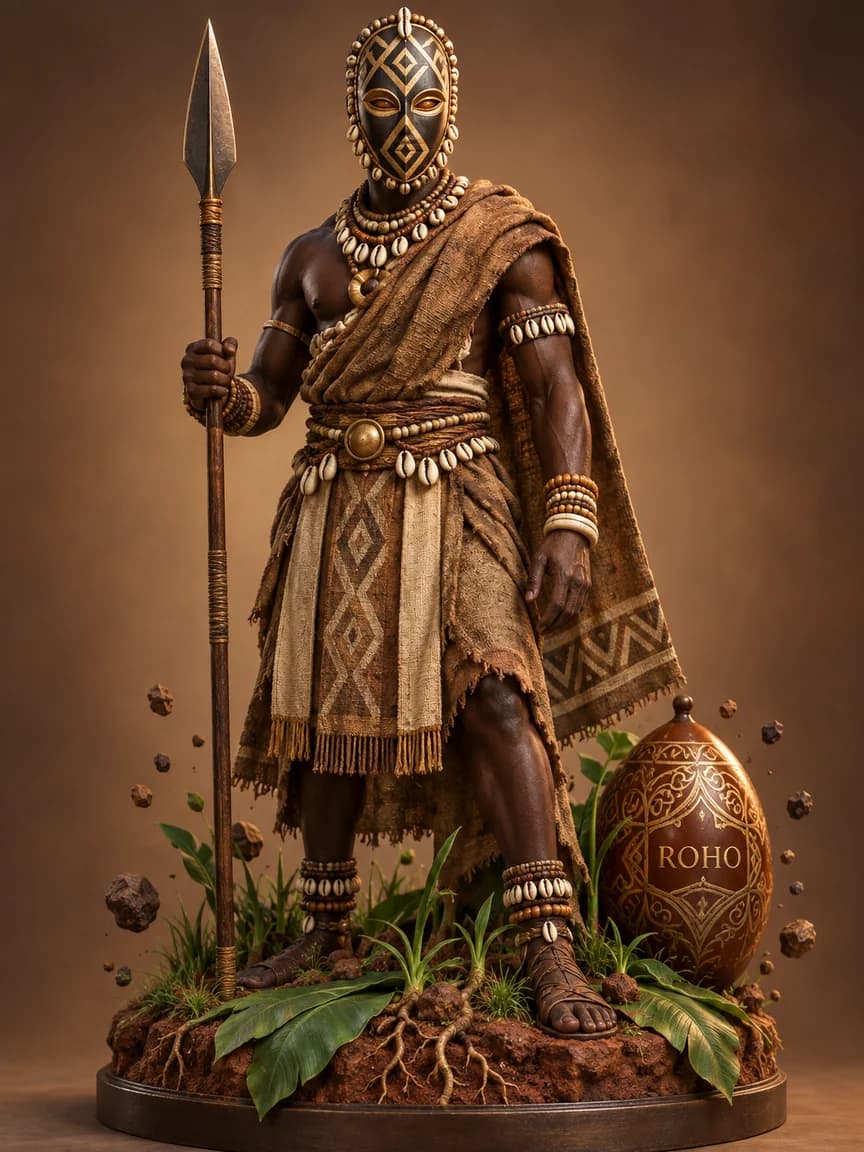
Blacksmith of the Cycle. MBALE transmutes matter through the sacred flame and keeps the tools of the thresholds. Bound to the Baganda pantheon.
Sacred Mask
An ancient ritual mask of fired clay, bronze and fossilised roots, engraved with symbols of fertility, embodiment of the power of Mbale
Era
Ancient cycle
Frequently asked questions
Is Mbale a god or a place?
Mbale is above all a sacred place: the hill of the district of Mpigi where the war god Kibuka is said to have fallen and been divinised. His national temple was erected there. The link is so close that Kibuka received the title of Kibuuka Omumbaale, Kibuka of Mbale. The toponym has thus become inseparable from the identity of the Baganda warrior god.
Why is the hill of Mbale important today?
Mbale remains a high place of spiritual memory of Buganda, associated with the cult of Kibuka. The relics of his temple, carried away at the beginning of the twentieth century by John Roscoe, are kept at the University of Cambridge. Since the 2020s, the Ndiga clan has demanded their restitution and plans to build a mausoleum at Mbale, in the district of Mpigi.
Related spirits
Further reading
Sources and references
- John Roscoe, Kibuka, the War God of the Baganda (Man, vol. 7) (1907)
- John Roscoe, The Baganda: An Account of their Native Customs and Beliefs (1911)
- Benjamin C. Ray, Myth, Ritual and Kingship in Buganda (1991)