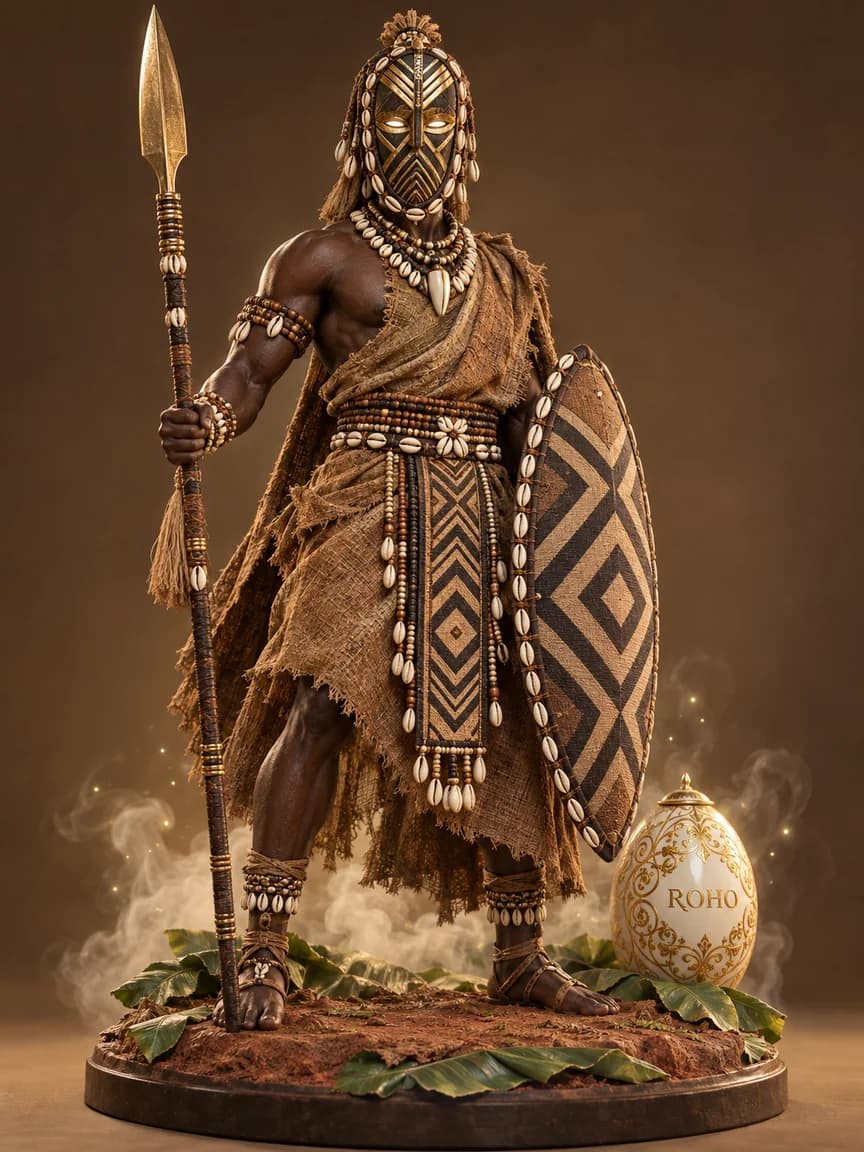
Kibuka
allyWar, protection
Kibuka is the great warrior lubaale of Baganda religion, invoked by sovereigns and armies in times of war, epidemic or great calamity. Tradition reports that he was, like his elder brother Mukasa, a mortal raised to the rank of deity. The most famous myth binds his destiny to king Nakibinge, at war with the neighbouring kingdom of Bunyoro: sent as reinforcement, Kibuka fought hidden in the clouds, from which he loosed arrows upon the enemy. Warned not to go near the captives, the Ganda army neglected the order; a Bunyoro captive escaped and revealed Kibuka's position to her people, and an archer struck him mortally in the chest. According to the versions, he collapsed onto a tree on the hill of Mbale, in Mpigi, where he was buried and deified, king Nakibinge raising a temple to him. This sanctuary at Mbale, a vast conical hut with a high thatched roof surrounded by a reed enclosure, formed a sacred court from which women were kept during their menses. At the beginning of the twentieth century, the missionary and anthropologist John Roscoe collected the relics of Kibuka's temple, today kept at the Museum of Archaeology and Anthropology of the University of Cambridge, which has begun a process of restitution to Uganda. Kibuka illustrates the martial dimension of the Ganda pantheon and the close bond between the balubaale and the royal function.
Powers & Attributes
Role in the ROHO universe
A fragment of Onionkupón's Breath, bound to one of the five elements of the cosmic balance.
Sacred Mask
A mask carved of ancient energy: a symbol of the cosmic force proper to its pantheon.
Era
3,000 to 1,000 BCE: Cycle of Elemental Powers
Spiritual Lesson
To understand the nature of one's own balance and the wisdom hidden behind every trial.
Words of the Spirit
“Iron remembers every hand that forged it.”
Frequently asked questions
How did Kibuka die according to the myth?
Sent to help king Nakibinge against Bunyoro, Kibuka fought hidden in the clouds, from which he struck the enemy. A Bunyoro captive escaped and revealed his position to her people. An archer then struck him with an arrow full in the chest. He collapsed, according to tradition, onto the hill of Mbale, where he was buried and then deified as god of war.
What became of the relics of Kibuka's temple?
At the beginning of the twentieth century, the missionary and anthropologist John Roscoe acquired the relics of Kibuka's sanctuary, which he described in the journal Man in 1907. They are today kept at the Museum of Archaeology and Anthropology of the University of Cambridge, which has begun a restitution process toward Uganda, notably toward Mbale in the Mpigi district.
Related spirits
Further reading
Sources and references
- John Roscoe, Kibuka, the War God of the Baganda (Man, vol. 7) (1907)
- John Roscoe, The Baganda: An Account of their Native Customs and Beliefs (1911)
- Benjamin C. Ray, Myth, Ritual and Kingship in Buganda (1991)
- Apolo Kagwa, The Customs of the Baganda (1934)