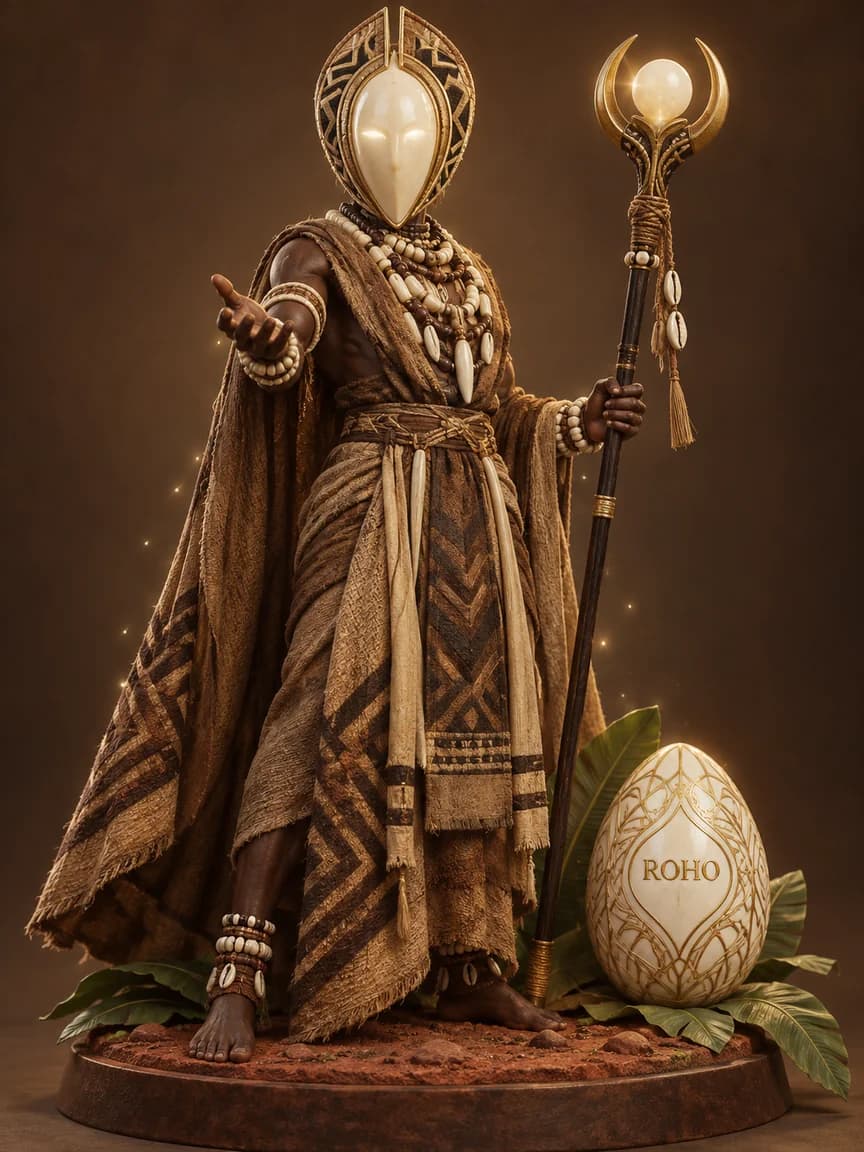
Katonda
allySupreme god, creator
In Baganda religion, Katonda stands at the summit of the spiritual hierarchy as creator of all things, yet he acts as a distant deity (deus otiosus) who does not intervene directly in the material world. His influence is exercised through the balubaale, the tutelary deities (singular lubaale) who form the national pantheon and receive an active cult in temples staffed by priests serving as oracles. According to the records of Apolo Kagwa, Katonda had few sanctuaries, mainly in the Kyaggwe region, and his actual cult remained modest compared with that of deities more involved in daily life, such as Mukasa. This ritual discretion accords with his transcendent nature: Katonda is the guarantor of cosmic order, the creator of Kintu, mythic ancestor of the Baganda, rather than a protector solicited from day to day. With the introduction of Christianity and Islam, his name was adopted by translators to designate the one God, which reinforced his stature as supreme figure in Ganda religious consciousness. His position as father of the pantheon makes him the theological point of origin of a system in which the balubaale, specialised spirits bound to the lakes, to war or to fecundity, relay divine action to humans and to the kabaka, the sovereign of Buganda.
Powers & Attributes
Role in the ROHO universe
A fragment of Onionkupón's Breath, bound to one of the five elements of the cosmic balance.
Sacred Mask
A mask carved of ancient energy: a symbol of the cosmic force proper to its pantheon.
Era
3,000 to 1,000 BCE: Cycle of Elemental Powers
Spiritual Lesson
To understand the nature of one's own balance and the wisdom hidden behind every trial.
Words of the Spirit
“Before the first word, there was already the breath.”
Frequently asked questions
Is Katonda the only god of the Baganda?
No. Katonda is the supreme creator, but Baganda religion includes a whole pantheon of deities called balubaale, such as Mukasa, Kibuka or Ggulu. Katonda is their father and head, but he remains a distant figure, while the balubaale receive a more regular cult and intervene directly in the life of the faithful and of the kingdom.
Why did Katonda have few temples?
Because he was conceived as a transcendent, distant god who does not act directly upon the world. The Baganda addressed their concrete requests (health, war, harvests) to the specialised balubaale. According to Apolo Kagwa, Katonda possessed only a few sanctuaries, mostly in the Kyaggwe region, his role belonging more to cosmic order than to daily worship.
Related spirits
Further reading
Sources and references
- John Roscoe, The Baganda: An Account of their Native Customs and Beliefs (1911)
- Apolo Kagwa, The Customs of the Baganda (1934)
- Benjamin C. Ray, Myth, Ritual and Kingship in Buganda (1991)