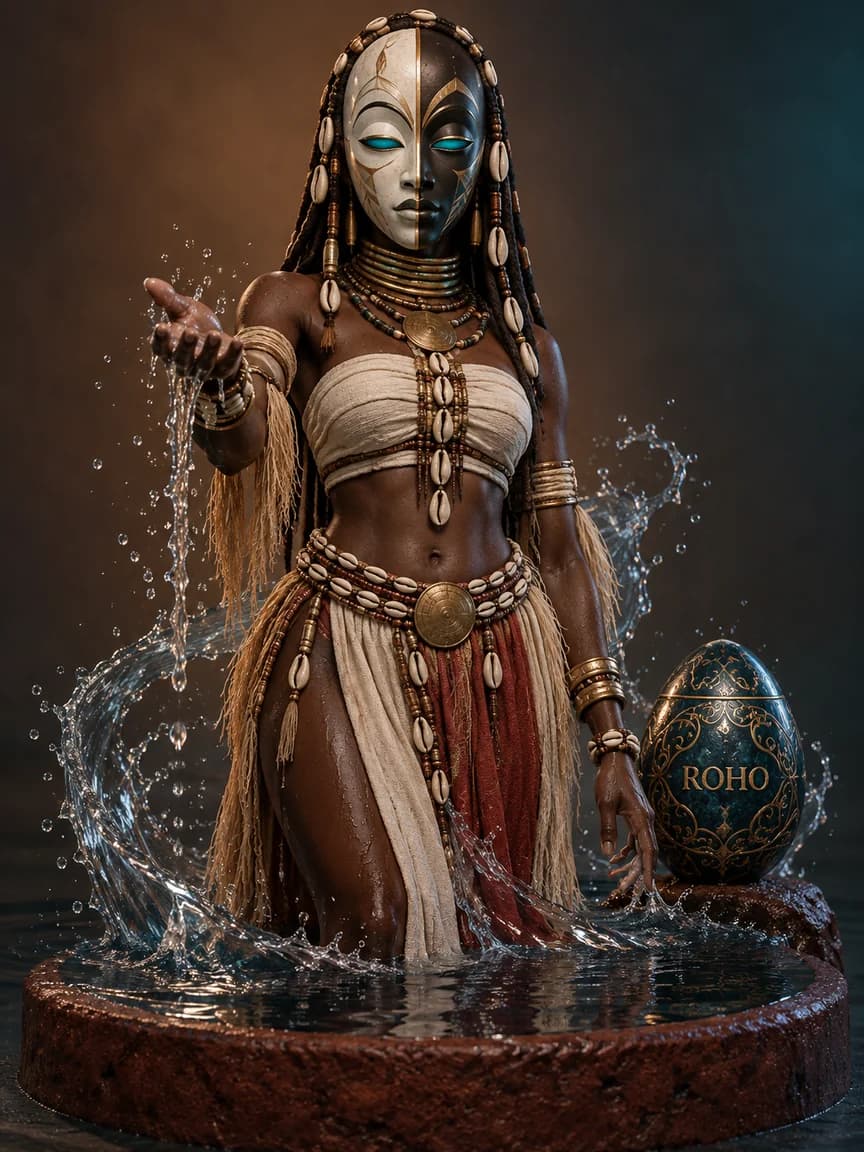
Kalunga
allyBoundary sea, passage of souls
Kalunga is a central notion of the cosmology of the Bantu peoples of Central Africa, in particular the Bakongo of the Congo basin. The word, from a proto-Bantu root evoking the idea of setting in order, designates at once a vast expanse of water, the Congo River, then the ocean, and the border that separates the world of the living from that of the dead. In Kongo thought, existence is divided between two mirrored domains: Ku Nseke, the land of the living, and Ku Mpemba, the realm of the ancestors. The Kalunga line, often represented as a surface of water, marks the threshold between these two worlds. Life is conceived there as a cycle set to the moments of the sun. To be born is to cross over from the spirit world; to die is to pass back across Kalunga to join the forebears. This border appears in the Kongo cosmogram, the dikenga or yowa cross, where water spirits, the simbi, guide the souls. Carried off by the Atlantic slave trade, the notion fed the Afro-diasporic traditions, where Kalunga became associated with the ocean crossed by the captives. Among other Bantu peoples, such as the Mbundu and the Chokwe, Kalunga also designates a deity of the sea and of death.
Powers & Attributes
Role in the ROHO universe
A fragment of Onionkupón's Breath, bound to one of the five elements of the cosmic balance.
Sacred Mask
A mask carved of ancient energy: a symbol of the cosmic force proper to its pantheon.
Era
3,000 to 1,000 BCE: Cycle of Elemental Powers
Spiritual Lesson
To understand the nature of one's own balance and the wisdom hidden behind every trial.
Words of the Spirit
“The waters keep the memory of what the earth forgets.”
Frequently asked questions
What does Kalunga mean?
In Kikongo, kalunga designates a vast expanse of water: first the Congo River, then the ocean. The word also names the symbolic border between the world of the living and that of the dead, crossed at birth and at death.
What is the Kalunga line in Kongo cosmology?
It is the threshold, often figured as a surface of water, that separates Ku Nseke, the land of the living, from Ku Mpemba, the realm of the ancestors. It occupies the centre of the Kongo cosmogram, the dikenga cross, where the souls circulate.
What bond does Kalunga have with the African diaspora?
Carried by the people enslaved during the Atlantic trade, the notion became associated with the ocean crossed toward the Americas. It fed several Afro-diasporic religious traditions, where Kalunga evokes at once the sea, death and the memory of the ancestors.
Related spirits
Further reading
Sources and references
- Robert Farris Thompson, Flash of the Spirit: African and Afro-American Art and Philosophy, 1983
- Wyatt MacGaffey, Religion and Society in Central Africa: The BaKongo of Lower Zaire, University of Chicago Press, 1986