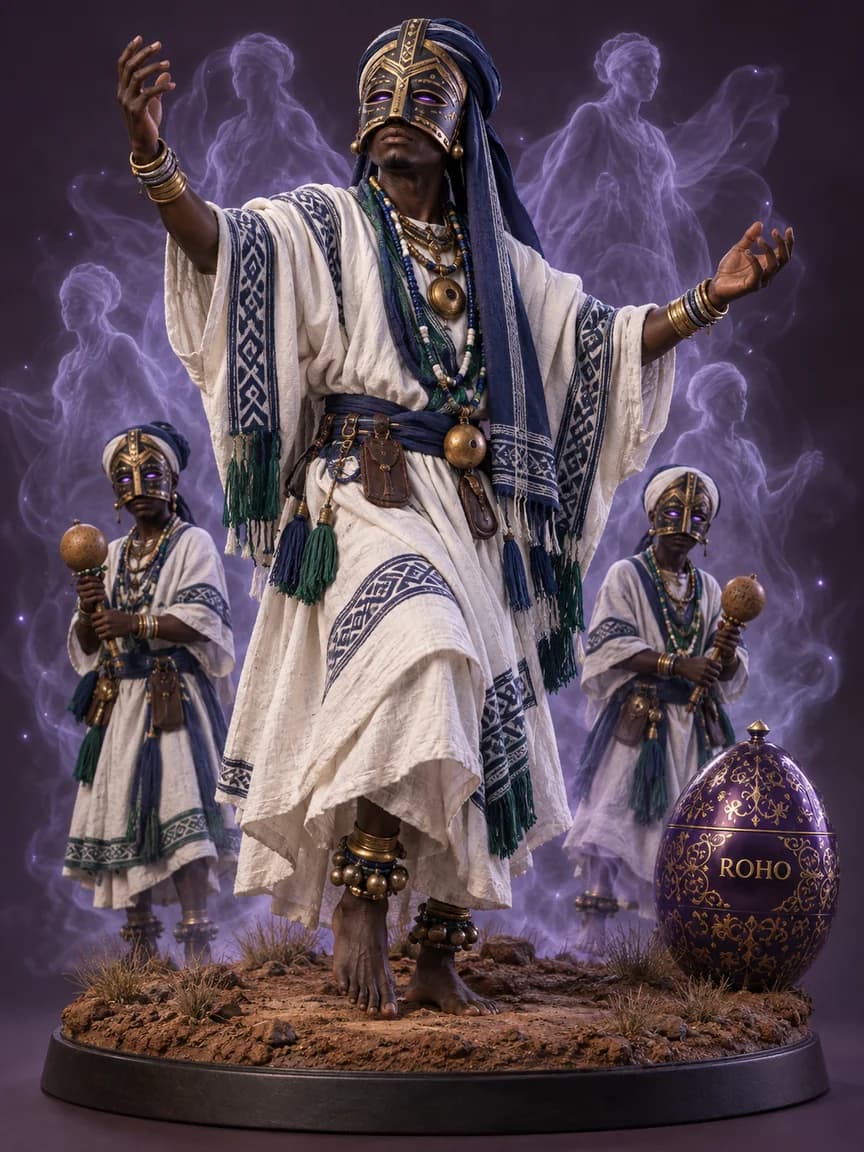
Bori
allyPossession spirits, trance
Bori, also called Maguzanci, designates the pre-Islamic animist religion of the Hausa people of West Africa, widespread in northern Nigeria and in Niger. The term bòòríí refers to the spiritual force that dwells in beings and things. At the heart of this tradition stand the iskoki, a multitude of spirits endowed with names, characters and powers of their own, divided between ancient entities called babbaku and later spirits described as Muslim. The cult takes the form of possession and trance rituals. To the sound of specific music and drums, adepts called yan bori, literally the children of bori, become the mounts of the spirits, whom they embody for the duration of the ceremony. Far from exorcism, the approach belongs to adorcism, which seeks to come to terms with the spirit and to heal the person. Bori long offered an important social and therapeutic role to women, with priestesses of high rank such as the Inna, the Mother of all. A state institution in some precolonial Hausa kingdoms, it receded with the Islamisation launched by the jihad of Usman dan Fodio around 1800, while surviving at the margins, sometimes in complementarity with Islam.
Powers & Attributes
Role in the ROHO universe
A fragment of Onionkupón's Breath, bound to one of the five elements of the cosmic balance.
Sacred Mask
A mask carved of ancient energy: a symbol of the cosmic force proper to its pantheon.
Era
3,000 to 1,000 BCE: Cycle of Elemental Powers
Spiritual Lesson
To understand the nature of one's own balance and the wisdom hidden behind every trial.
Words of the Spirit
“The spirit crosses what the body cannot.”
Frequently asked questions
What does the word Bori mean?
Bòòríí is a Hausa term designating the spiritual force residing in beings and objects. By extension, it names the possession cult that allows one to enter into relation with the spirits, called iskoki.
What does a bori ritual consist of?
To the sound of drums and melodies dedicated to each spirit, adepts named yan bori enter trance and become the mounts of the iskoki. The ceremony aims to heal, protect or restore a balance, in a logic of adorcism rather than exorcism.
Does Bori still exist today?
Most Hausa converted to Islam between 1800 and the middle of the twentieth century. Bori has strongly receded but survives at the margins, sometimes in complementarity with Muslim practices, and keeps a notable role for certain communities of women.
Related spirits
Further reading
Sources and references
- A. J. N. Tremearne, The Ban of the Bori: Demons and Demon-Dancing in West and North Africa, 1914
- Adeline Masquelier, Prayer Has Spoiled Everything: Possession, Power, and Identity in an Islamic Town of Niger, Duke University Press, 2001