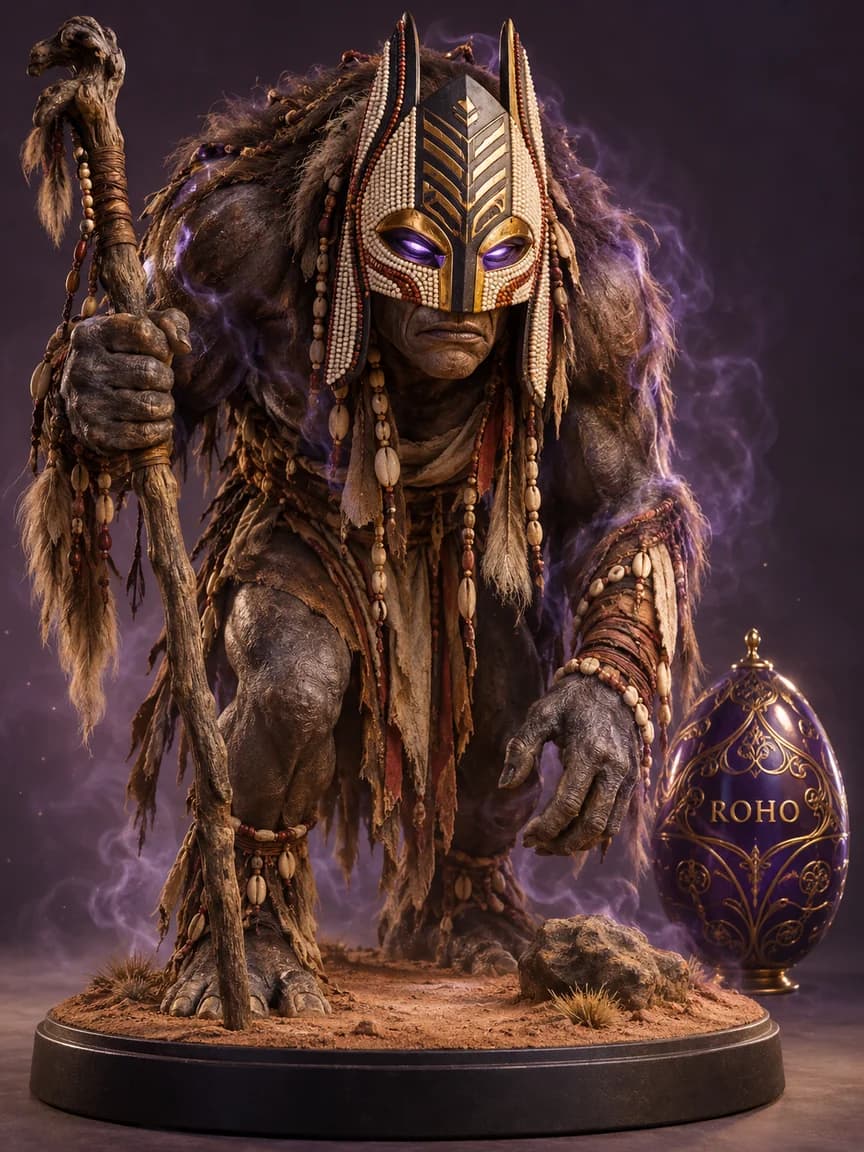
Dodo
neutralDemon
Dodo designates, in the traditions of West Africa, in particular among the Hausa of Nigeria and Niger, a monstrous, man-devouring creature. The tales describe it as a giant ogre, sometimes furnished with long hair and a tail, able to swallow beasts and humans, haunting isolated trees such as the baobab or the tamarind. A shapeshifter, it takes the form of various animals to deceive its victims and often serves as a bogeyman in the tales meant for children. In Hausa animism, the term dodo also applies to malevolent spirits to whom certain people offer sacrifices to obtain help in harmful deeds, which attaches the figure to witchcraft. Certain readings see in it an old storm deity progressively reduced to the rank of demon under the influence of the monotheistic religions.
Powers & Attributes
Role in the ROHO universe
Weaver of the invisible threads. DODO handles the subtle energies and teaches the language of correspondences. Bound to the Khoisan pantheon. Its alignment depends on the invoker's protocol.
Sacred Mask
An ancient ritual mask of vegetable ivory, amethyst and sacred wood, engraved with symbols of witchcraft, embodiment of the power of Dodo
Era
Ancient cycle
Frequently asked questions
What is the Dodo in African folklore?
The Dodo is a man-devouring ogre of the tales of West Africa, above all among the Hausa. Giant and shapeshifting, it haunts isolated trees and swallows its victims. It often serves as a bogeyman in the tales meant to warn children.
Why is the Dodo bound to witchcraft?
In Hausa animism, dodo also designates malevolent spirits. Tradition reports that certain people offer them sacrifices to obtain help in harmful undertakings, which associates the figure with the practices of witchcraft and magic.
Does the Dodo belong to Khoisan mythology?
No. The documented sources attach the Dodo to the Hausa and West African traditions, not to the Khoisan peoples of southern Africa. No figure named Dodo is attested in Khoisan mythology, which calls for caution about this classification.
Related spirits
Further reading
Sources and references
- Arthur John Newman Tremearne, Hausa Superstitions and Customs: An Introduction to the Folk-Lore and the Folk (1913)