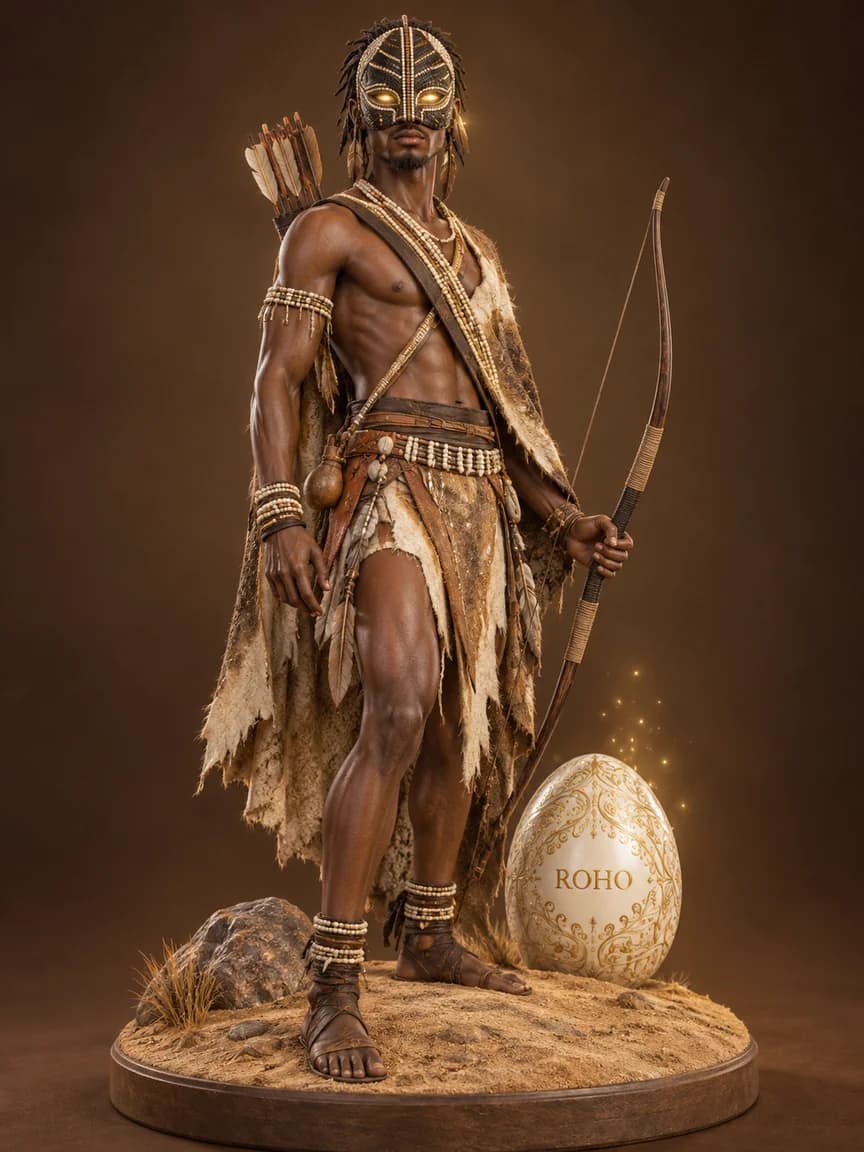
Heise
allyDemigod
Heise, more often spelled Heiseb, is a Nama and Damara name of the demigod hero Heitsi-eibib, a major figure of the Khoikhoi and more broadly Khoisan mythology of southern Africa. Hunter, sorcerer and warrior, he is famed for his intimate knowledge of the animal world, tradition showing him wandering the bush where he knows the name of every animal. The narratives credit him with a prodigious birth, a gemsbok wife and offspring half human, half antelope: traits that underline his closeness to the fauna. A trickster able to change form, he dies and is reborn several times over, which makes him a figure of renewal attached to the cycle of life and death. His most famous exploit is the killing of the monster Ga-gorib. A cult is rendered to him before cairns, heaps of stones presented as his multiple tombs, scattered across southern Africa.
Powers & Attributes
Role in the ROHO universe
Voice of its pantheon. HEISE carries the memory of its tradition and weaves a thread into the Mabioni. Bound to the Khoisan pantheon.
Sacred Mask
An ancient ritual mask of sacred wood, old metal and black stone, engraved with symbols of animals, embodiment of the power of Heise
Era
Ancient cycle
Frequently asked questions
Is Heise the same character as Heitsi-eibib?
Yes. Heise, a shortened form of Heiseb, is a Nama and Damara name of the hero Heitsi-eibib. It is the same semi-divine figure of Khoisan mythology, honoured under several names according to the groups and regions of southern Africa.
Why is Heise bound to the animal world?
Tradition describes him roaming the bush knowing the name of every animal. The narratives give him a gemsbok wife and children half human, half antelope, and hold him for a master of the hunt, which anchors the character in knowledge of the fauna.
What is the role of the cairns associated with Heise?
Heiseb, like Heitsi-eibib, is associated with cairns, heaps of stones reputed to be his multiple tombs. Travellers left a stone or a branch there as a sign of respect and to ask for luck in the hunt and protection on the road.
Related spirits
Further reading
Sources and references
- Theophilus Hahn, Tsuni-Goam: The Supreme Being of the Khoi-Khoi, 1881
- Isaac Schapera, The Khoisan Peoples of South Africa: Bushmen and Hottentots, 1930