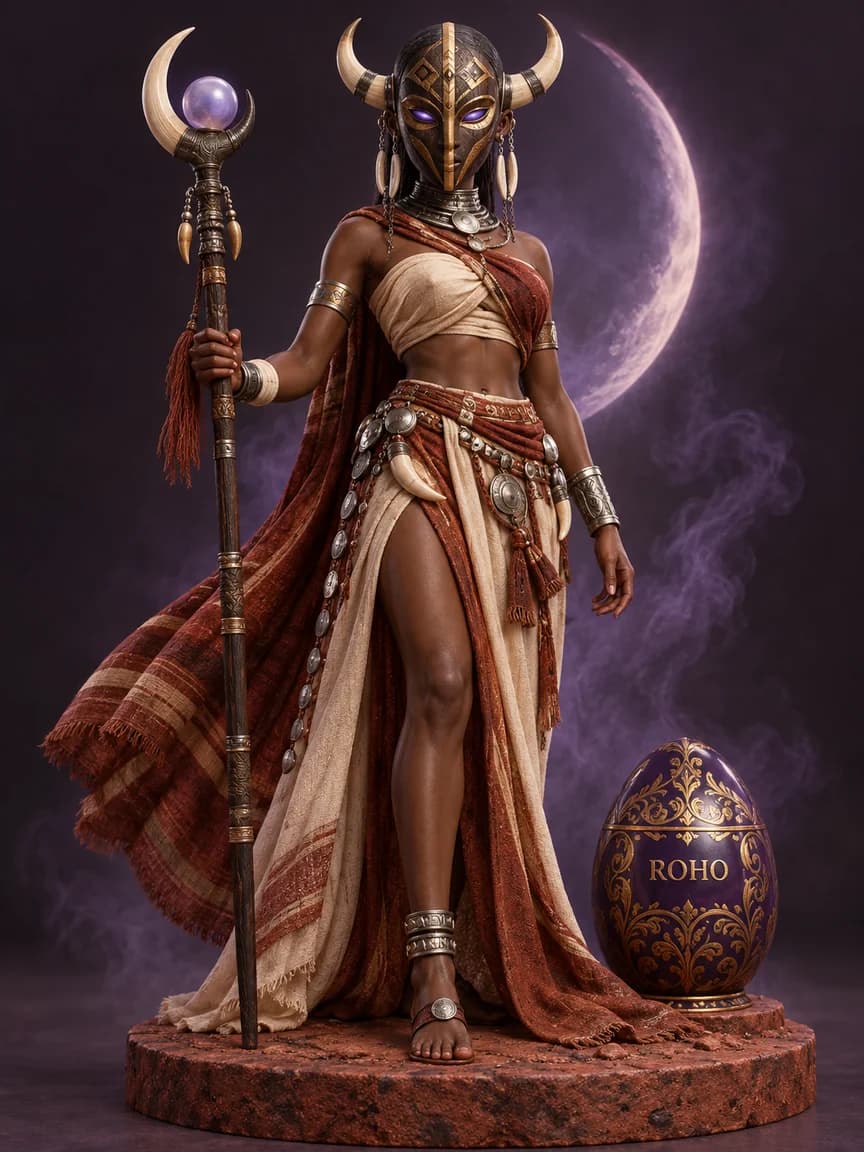
Andriamahilala
allyHero
Andriamahilala is, in Malagasy mythology, the first woman, wife of the first man Andriambahomanana. The narrative brings in the creator Zanahary, who observes that the couple has begotten so numerous a posterity that the generations multiply without end. To restore a balance, Zanahary asks the couple to choose the form that death will take. Andriamahilala chooses to die in the manner of the moon, that is, to disappear and then be reborn each month, while her husband opts for the model of the banana tree. This choice associates her with the lunar cycles and with the idea of a celestial, periodic renewal. The myth thus explains the introduction of death among humans as a response to their proliferation, and distinguishes two ways of conceiving finitude and regeneration. Andriamahilala appears as a primordial figure of Malagasy cosmology, bound to the moon and to renewal.
Powers & Attributes
Role in the ROHO universe
Keeper of the glow. ANDRIAMAHILALA holds the night open to dreams and watches the thresholds of the invisible. Bound to the Malagasy pantheon.
Sacred Mask
An ancient ritual mask of vegetable ivory, amethyst and sacred wood, engraved with symbols of death and moon, embodiment of the power of Andriamahilala
Era
Ancient cycle
Frequently asked questions
Who is Andriamahilala?
She is the first woman of Malagasy mythology and the wife of Andriambahomanana, the first man. The couple, bound to the creator Zanahary, is at the origin of humanity.
Why does she choose to die like the moon?
When Zanahary asks how death should manifest, Andriamahilala chooses the lunar model: to disappear and be reborn each month. This choice associates her with the cycle of the moon and with renewal.
What does this myth mean?
It explains the appearance of death as a response to the multiplication of humans, and sets against each other two forms of finitude: that of the moon chosen by Andriamahilala and that of the banana tree chosen by her husband.
Related spirits
Further reading
Sources and references
- Charles Renel, Ancêtres et dieux : anciennes religions de Madagascar (1920)
- Alfred Grandidier et Guillaume Grandidier, Ethnographie de Madagascar, tome III : les croyances et la vie religieuse à Madagascar (1917)