Andriambahomanana
allyHero
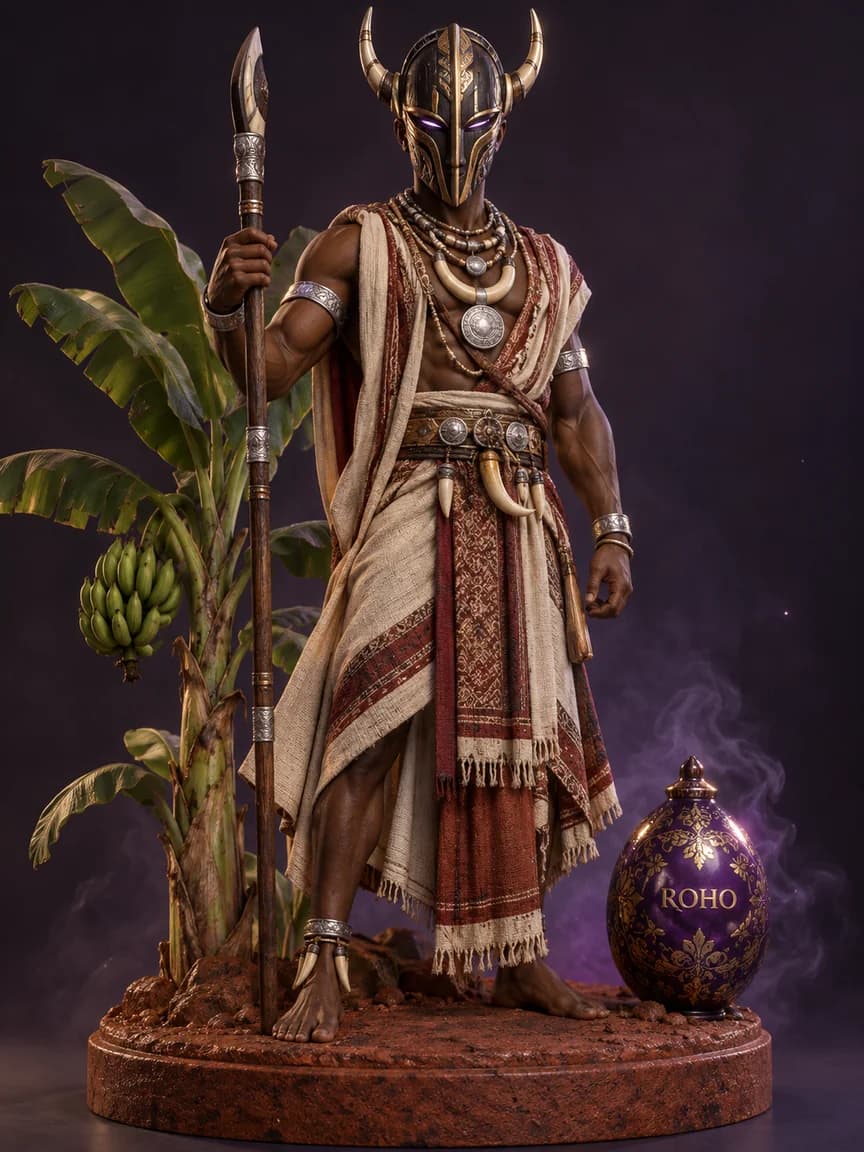
Andriambahomanana is, in Malagasy mythology, the first man, husband of the first woman Andriamahilala. The narrative brings in the creator Zanahary, who observes that the couple has given birth to a posterity so numerous that the generations follow one another without end. To introduce a balance, Zanahary invites the couple to choose the form that death will take. Andriambahomanana chooses to die in the manner of the banana tree: the plant that dies but leaves behind new shoots that carry it on. His wife, for her part, opts for the model of the moon, which disappears and is reborn each month. This choice associates Andriambahomanana with an earthly regeneration through posterity, where the moon evokes a celestial renewal. The myth accounts for the appearance of death among humans as a response to their proliferation, and grounds two complementary conceptions of finitude. Andriambahomanana thus figures as the primordial male ancestor of Malagasy cosmology.
Powers & Attributes
Role in the ROHO universe
Ferryman of souls. ANDRIAMBAHOMANANA ensures the circulation of souls and prevents stagnation between the worlds. Bound to the Malagasy pantheon.
Sacred Mask
An ancient ritual mask of vegetable ivory, amethyst and sacred wood, engraved with symbols of death, embodiment of the power of Andriambahomanana
Era
Ancient cycle
Frequently asked questions
Who is Andriambahomanana?
He is the first man of Malagasy mythology and the husband of Andriamahilala, the first woman. The couple, bound to the creator Zanahary, is at the origin of humanity.
Why does he choose to die like the banana tree?
Asked by Zanahary about the form of death, he chooses the banana tree, the plant that dies but gives new shoots. This model symbolises survival through posterity rather than through a cyclical return.
What is the reach of this myth?
It explains the introduction of death as a way of containing the multiplication of humans, and sets side by side two visions of finitude: that of the banana tree and that of the moon chosen by his wife.
Related spirits
Further reading
Sources and references
- Charles Renel, Ancêtres et dieux : anciennes religions de Madagascar (1920)
- Alfred Grandidier et Guillaume Grandidier, Ethnographie de Madagascar, tome III : les croyances et la vie religieuse à Madagascar (1917)