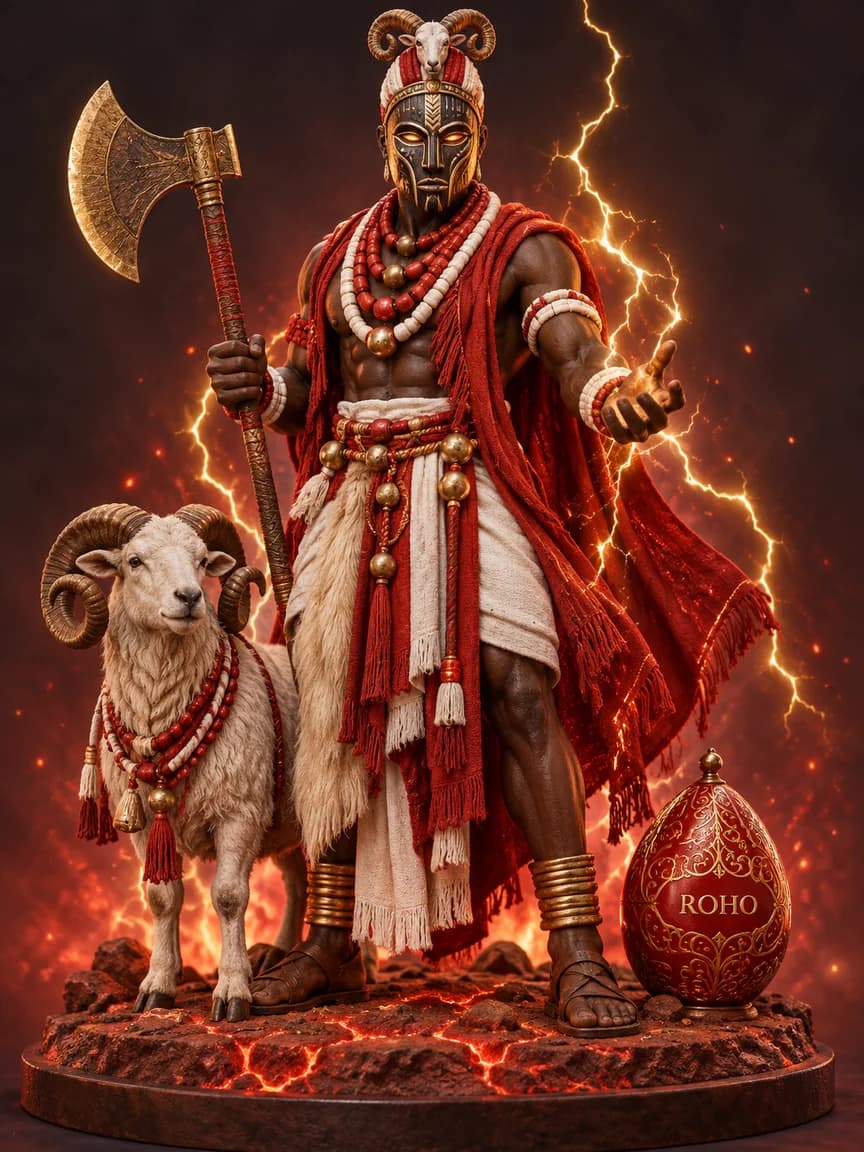
Amadioha
allyThunder, justice
Amadioha reigns over the stormy sky of the Igbo, above all in the south of their territory, where his great sanctuary at Ozuzu, in Etche country, drew pilgrims from afar. Alusi of thunder and lightning, known elsewhere as Kamalu, Kamanu or Ofufe, he embodies celestial justice: his bolt strikes the perjurer, the thief, the poisoner, the oppressor. A person struck by lightning was held to be condemned by him; they were not mourned, and their goods reverted to the god. This is why the most solemn oaths are sworn in his name. The ram is his animal, red and white his colours, Afo, one of the four days of the Igbo week, his sacred day. Often associated with Ala, the earth goddess, whose celestial counterpart he is in the mbari houses of the Owerri region, he forms with her the couple of the fertilising sky and the nourishing earth. Arthur Glyn Leonard noted as early as 1906 the reverential fear his thunder inspired among the peoples of the Lower Niger. To this day his name serves as exclamation and imprecation in everyday Igbo speech: a sign of the place he keeps in the collective imagination.
Powers & Attributes
Role in the ROHO universe
A fragment of Onionkupón's Breath, bound to one of the five elements of the cosmic balance.
Sacred Mask
A mask carved of ancient energy: a symbol of the cosmic force proper to its pantheon.
Era
3,000 to 1,000 BCE: Cycle of Elemental Powers
Spiritual Lesson
To understand the nature of one's own balance and the wisdom hidden behind every trial.
Words of the Spirit
“Lightning does not strike at random.”
Frequently asked questions
Who is Amadioha in Igbo religion?
Amadioha is the alusi of thunder and lightning in the odinani of the Igbo of Nigeria. A celestial dispenser of justice, he strikes perjurers, thieves and oppressors with his bolt. Associated with the sky, the ram and the colour red, he presides over solemn oaths, and his sacred day is Afo, one of the four days of the Igbo week.
What does death by lightning mean according to odinani?
Death by lightning was held to be Amadioha's direct judgement: the victim was reputed guilty of a hidden fault: perjury, theft or poisoning. They were not publicly mourned, ordinary burial was refused them, and their goods could revert to the god's sanctuary. This belief made Amadioha the dreaded guarantor of oaths and of the given word.
Where was Amadioha worshipped?
His cult is above all alive in the south of Igboland. The most famous sanctuary stands at Ozuzu, in Etche country, in present-day Rivers State, where people came from afar to swear oaths and seek justice. Depending on the region, the thunder god also bears the names Kamalu, Kamanu or Ofufe, and the ram remains his emblematic animal.
Related spirits
Further reading
Sources and references
- Arthur Glyn Leonard, The Lower Niger and Its Tribes (1906)
- Herbert M. Cole et Chike C. Aniakor, Igbo Arts: Community and Cosmos (1984)
- Elizabeth Isichei, A History of the Igbo People (1976)