Asanbosam or Sasabonsam: Ghana's iron-toothed tree monster
Long legs hanging from a silk-cotton tree, teeth of iron, and a vampire label that came later than you'd think.
"Well do I remember our greatest terror when out at night on a forest path." Mary Kingsley wrote that in 1899, remembering the bush tracks of West and Central Africa. She believed the thing her companions feared was a Sasabonsum, and she kept running into it from Mount Cameroon to the Ogowe. You may know it as the Asanbosam, the African vampire of a hundred online lists. The older sources tell a stranger story.
What is an Asanbosam?
The Asanbosam, or Sasabonsam, is a monster of Akan belief, known above all from the Asante of Ghana. It lives deep in the forest, sits high in the great trees and lets its legs hang down to catch whoever walks below. Hunters who never came home, wrote the anthropologist R. S. Rattray, were supposed to have been taken by it.
It doesn't work alone, either. Rattray places it in league with witches, the abayifo, and with the mmoatia, the little forest folk. It is hostile to people in general and, he adds, to true priests in particular.
Asanbosam vs Sasabonsam: is there a difference?
As far as we can trace it, they are one creature under several spellings. A. B. Ellis wrote Sasabonsum in 1887. Rattray wrote sasabonsam and asasabonsam, linking the word to bonsam, which he glosses as a devil or evil spirit. We didn't find Asanbosam in either author. That form turns up in English books about vampires: Georgess McHargue's Meet the Vampire in 1979, then Matthew Bunson's The Vampire Encyclopedia in 1993, which also gives asanbonsam.
Some recent bestiaries and websites split them in two, one winged, one hook-footed. We found no early source that does. Our Codex currently keeps a Sasabonsam entry and an Asanbosam entry, each pointing to the other.
What does it look like?
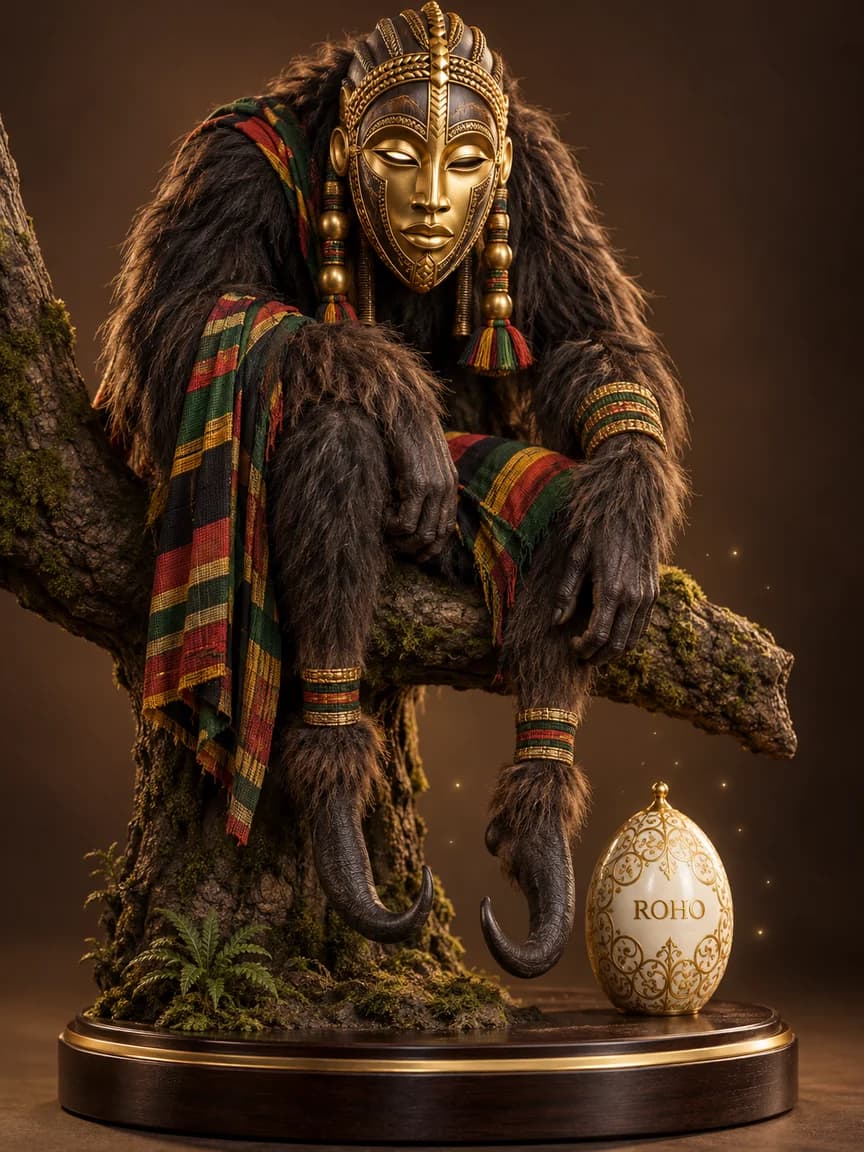
It depends who you ask, and when. Rattray himself gave two portraits. In Ashanti Proverbs (1916) it has human shape, iron teeth and hooks for feet, and its legs reach the ground from the treetop. There are male, female and little ones, and a big fungus on forest trees is called sasabonsam kyew, its hat. Eleven years later, he describes something else:
« It is covered with long hair, has large blood-shot eyes, long legs, and feet pointing both ways. It sits on high branches of an odum or onyina tree and dangles its legs, with which at times it hooks up the unwary hunter. R. S. Rattray, Religion and Art in Ashanti, 1927 »
Ellis, forty years before, had seen a whole class of local deities: human in shape, red, long-haired, friends of witches, with a taste for human flesh, and at home among silk-cotton trees or wherever the earth runs red. Kingsley's version has one side of the body rotting and the other healthy, and your survival depends on which side you brush against. Remember that these are British writers of the colonial era looking in from outside, and that stories vary from one region and lineage to the next.
| Source | Spelling | What it describes |
|---|---|---|
| A. B. Ellis, 1887 | Sasabonsum | Human shape, red, long hair; silk-cotton trees and red earth |
| R. S. Rattray, 1916 | Asasabonsam, sasabonsam | Human shape, iron teeth, hooks for feet |
| R. S. Rattray, 1927 | Sasabonsam | Long hair, bloodshot eyes, feet pointing both ways |
| Osei Bonsu, carvings | Sasabonsam | Beard, horns, bat-like wings, spiralling legs |
| M. Bunson, 1993 | Asanbosam, asanbonsam | Listed among Africa's vampires |
Does the Sasabonsam have wings?
Not in Ellis, and not in the Rattray passages we read. The wings come through in sculpture. The Asante carver Osei Bonsu made sasabonsam figures with a human face, beard, horns, bat-like wings and long looping legs. The British Museum holds one, and Cambridge's Museum of Archaeology and Anthropology holds another it attributes to him. The Cambridge record reads the type as partly based on the Christian devil, yet rooted in Ghanaian belief.
Is it really a vampire?
Here is the twist. When Rattray uses the phrase "human vampires" in 1916, he means the bayifo, the witches, not the sasabonsam. The two are close: an Asante proverb says that when a sasabonsam goes to a funeral, it lodges at a witch's house. But in the early passages we read, the monster catches and devours. None of them has it drinking blood.
The vampire label seems to arrive with English-language vampire books, which keep the trees and the iron teeth and sometimes add details you won't find in Rattray. McHargue has it nipping only its victims' thumbs. The label isn't absurd, but treat it as a translation from the outside.
From the Asante forest to Jamaica
The name crossed the Atlantic. In 1934, Joseph J. Williams, quoting the Jamaican novelist Herbert G. de Lisser, reported the belief that the Sasabonsam's favourite home is the ceiba, the great silk-cotton tree. Jamaican fiction has kept it alive: in Michelle Cliff's No Telephone to Heaven (1987) the fire-eyed monster dangles his legs from a silk-cotton tree, and in Marlon James's The Book of Night Women (2009) the Sasabonsam lives in the cotton tree.
We found no eighteenth-century text naming it on the island, so the often-repeated eighteenth-century date stays unproven in the sources we could read. The tree is the striking part. Ellis's bombax, Rattray's onyina, Jamaica's ceiba: one tree on both sides of the ocean.
The Sasabonsam in La Légende de ROHO
The Sasabonsam is one of the four adversaries in Ebandeli, the first volume of the fantasy saga La Légende de ROHO, alongside Adze, Tokoloshe and Anansi, called Anasy in the book. The book calls it the hunter of souls, and we'll leave it there. The premise is simple enough: "The last Guardian is an old man at the end of his watch." A curse returns the spirits to infancy, and "He has to return each mask to a spirit who is now a child." The book is in French for now. The Codex, with its 389 spirits, is open to everyone in English.
To go further, read our guide to Akan gods and goddesses, and browse the Akan spirits in the Codex.
Sources
- ◆A. B. Ellis, The Tshi-Speaking Peoples of the Gold Coast of West Africa, Chapman and Hall, 1887, pp. 34-37.
- ◆Mary H. Kingsley, West African Studies, Macmillan, 1899.
- ◆R. S. Rattray, Ashanti Proverbs, Clarendon Press, 1916, proverb no. 56.
- ◆R. S. Rattray, Religion and Art in Ashanti, Oxford University Press, 1927.
- ◆Joseph J. Williams, Psychic Phenomena of Jamaica, 1934.
- ◆Georgess McHargue, Meet the Vampire, 1979.
- ◆Michelle Cliff, No Telephone to Heaven, 1987.
- ◆Matthew Bunson, The Vampire Encyclopedia, Thames & Hudson, 1993.
- ◆Marlon James, The Book of Night Women, 2009.
- ◆Museum of Archaeology and Anthropology, University of Cambridge, record of a sasabonsam carving attributed to Osei Bonsu.
- ◆British Museum, sasabonsam carving by Osei Bonsu, no. Af1935,1212.1.
Questions fréquentes
What is an Asanbosam?
An Asanbosam, also spelled Sasabonsam or asasabonsam, is a monster of Akan belief in Ghana. It sits high in forest trees and hangs down its long legs to catch people below. Early accounts give it long hair, bloodshot eyes, iron teeth and hooks for feet.
What is the difference between Asanbosam and Sasabonsam?
In the sources we read, they are the same creature. Sasabonsam, asasabonsam and sasabonsum are the older written forms, while Asanbosam is mostly the form used in English books about vampires. Treating them as two creatures appears only in recent bestiaries and websites.
Is the Sasabonsam a vampire?
Modern vampire encyclopedias list it as one. In the early passages we read it catches and eats people rather than drinking blood, and R. S. Rattray keeps the phrase human vampires for the bayifo, the witches who are its allies.
Does the Sasabonsam have wings?
Some depictions do. Carvings by the Asante sculptor Osei Bonsu show bat-like wings, along with horns and a long beard. The written accounts we read by A. B. Ellis and R. S. Rattray do not mention wings.