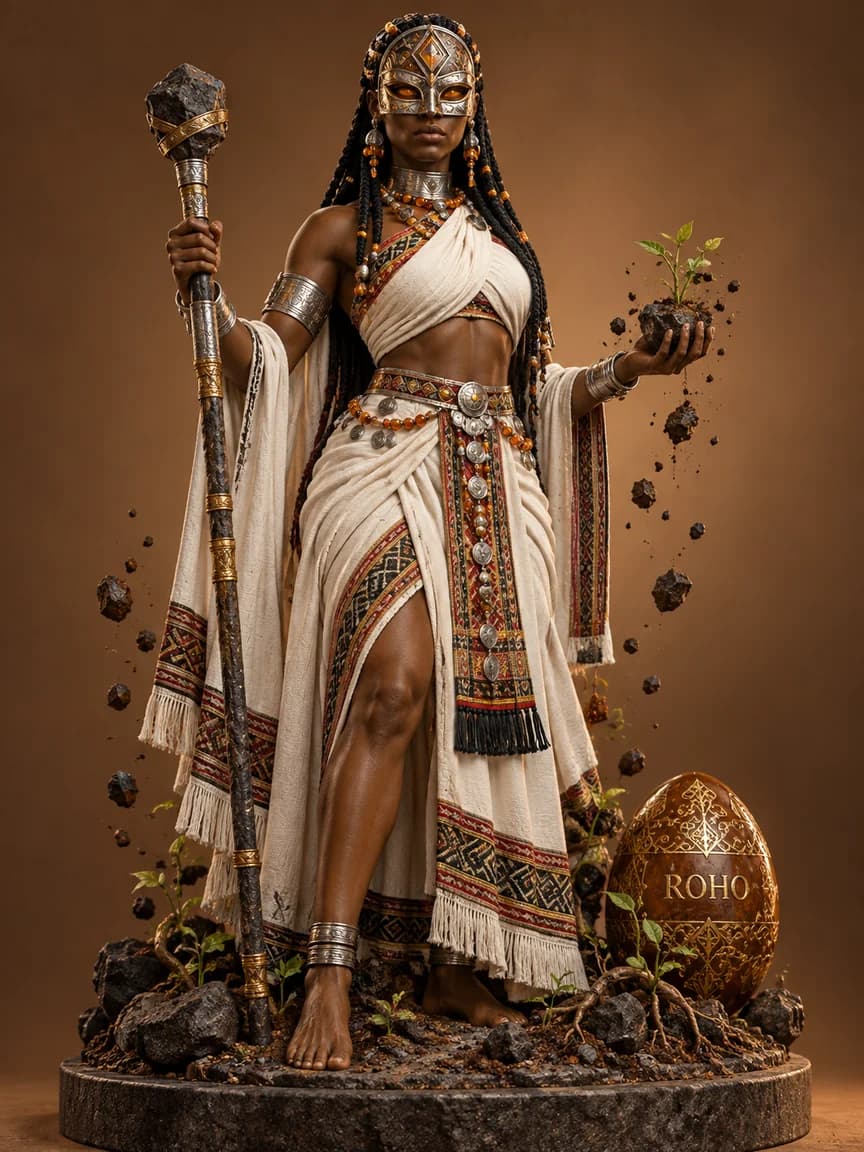
Meder
allyGod
Meder, also transcribed Medr, is an earth deity of the pre-Christian pantheon of Aksum, in the north of present-day Ethiopia and in Eritrea. Its name means earth or soil in Ge'ez. It figures among the powers invoked in the royal inscriptions of king Ezana of Aksum, within a triad gathering Astar, an astral deity, Beher, associated with the sea and the earth, and Meder itself. The epigraphists consider Meder and Beher as very close chthonic deities, sometimes interchangeable, both bound to the earth and to fertility, certain sources describing Meder as a figure of the earth mother. After his conversion to Christianity, Ezana kept the term medr, the earth, to designate the extent of the power of the Christian God, master of heaven and earth. Meder thus belongs to the South Arabian and Aksumite religious heritage of the Horn of Africa, alongside Astar, Beher and Mahrem, the god of war.
Powers & Attributes
Role in the ROHO universe
Mother of the soil. MEDER holds the fertility of the earth and blesses wombs and seeds. Bound to the Ethiopian pantheon.
Sacred Mask
An ancient ritual mask of fired clay, bronze and fossilised roots, engraved with symbols of earth, embodiment of the power of Meder
Era
Ancient cycle
Frequently asked questions
Who is Meder in the pantheon of Aksum?
Meder, or Medr, is the earth deity of the pre-Christian kingdom of Aksum. Its name means earth in Ge'ez, and it is invoked in the inscriptions of king Ezana alongside Astar and Beher.
What link does Meder have with Beher?
The specialists consider Meder and Beher as very close chthonic deities, sometimes interchangeable, both bound to the earth and to fertility. Beher is also associated with the sea.
What becomes of the name Meder after the Christianisation of Aksum?
After his conversion, king Ezana kept the term medr, the earth, in his inscriptions to designate the power of the Christian God over heaven and earth, marking a linguistic and religious continuity.
Related spirits
Further reading
Sources and references
- Wikipedia, Beher (god)
- Sewasew, Médr
- Inscriptions du roi Ezana d'Aksum (RIÉ 185 et RIÉ 188)