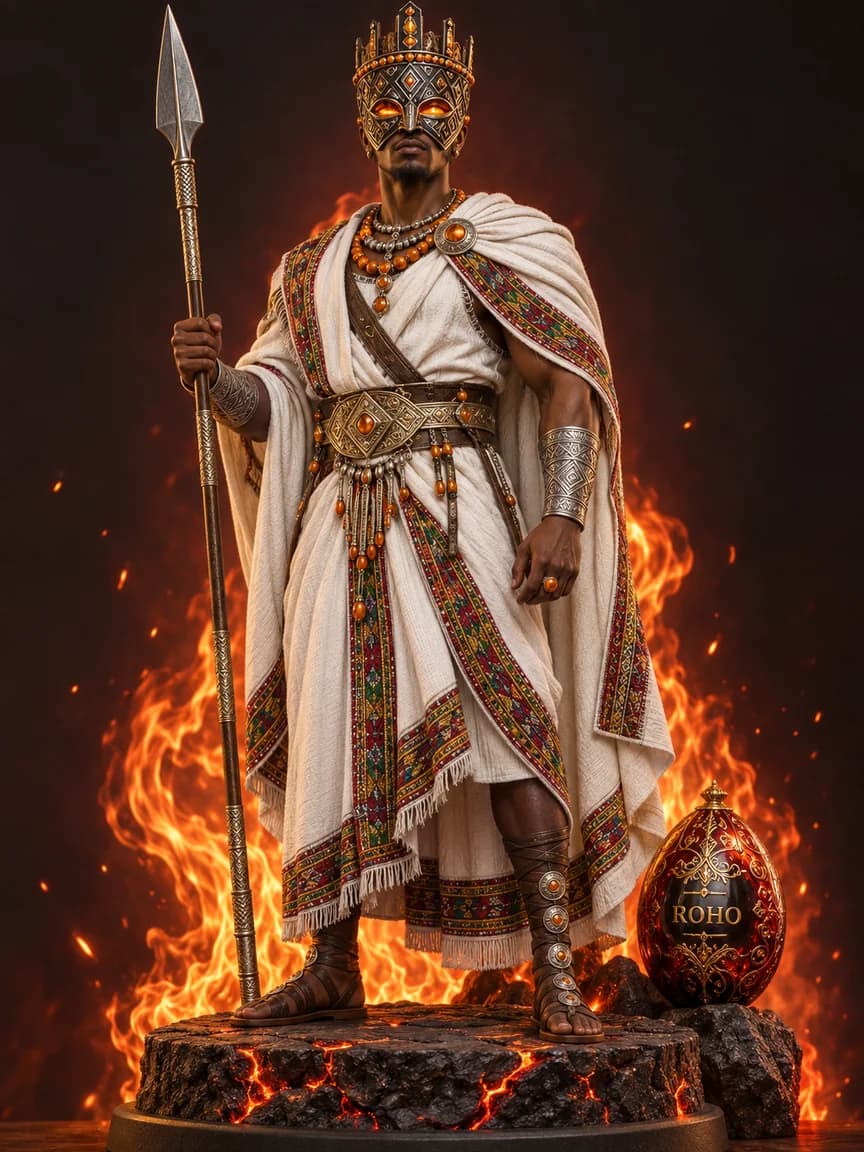
Mahrem
allyGod
Mahrem is the war god of the kingdom of Aksum, an ancient African power situated on the high plateaus of present-day northern Ethiopia and Eritrea. In the pre-Christian Aksumite pantheon, which includes notably Astar, a celestial deity, as well as Beher and Meder, Mahrem holds a place apart: he is the dynastic god, the personal protector of the sovereign. The kings of Aksum proclaim themselves in their inscriptions sons of Mahrem, invincible before the enemy, and the Greek versions of these texts translate his name by Ares, the Greek god of war. After their victorious campaigns, the sovereigns, such as Ezana in the fourth century of our era, dedicate to him thrones of stone, statues and animal sacrifices, as reported by the royal inscriptions studied by Stuart Munro-Hay and David Phillipson. This royal cult dies out with the conversion of king Ezana to Christianity, towards the middle of the fourth century: the last inscriptions of the reign replace the invocation of Mahrem with that of the Lord of Heaven. Mahrem bears witness to the ancient religious links between the Horn of Africa and South Arabia, where related deities were honoured, and illustrates the sacred dimension of Aksumite kingship.
Powers & Attributes
Role in the ROHO universe
Armed sentinel. MAHREM stands between the community and the threat, and decides when the balance is broken. Bound to the Ethiopian pantheon.
Sacred Mask
An ancient ritual mask of obsidian, forged metal and cooled lava, engraved with symbols of war, embodiment of the power of Mahrem
Era
Ancient cycle
Frequently asked questions
Who is Mahrem?
Mahrem is the god of war and the protector of kingship in the empire of Aksum, in ancient Ethiopia and Eritrea. The dynastic deity of the pre-Christian Aksumite pantheon, he guarantees the sovereign's military victory. The kings of Aksum present themselves in their inscriptions as sons of Mahrem the invincible, and the Greek versions of these texts assimilate him to Ares, the Greek god of war.
Why did the kings of Aksum call themselves sons of Mahrem?
Divine filiation grounded the legitimacy of Aksumite power: to call oneself son of Mahrem, the invincible god of war, made the king his representative on earth and placed his conquests under divine protection. After their victories, the sovereigns dedicated to him thrones of stone, statues and sacrifices, gestures recorded in the great royal inscriptions of Aksum, notably those of king Ezana.
What became of the cult of Mahrem?
The cult of Mahrem disappears with the conversion of king Ezana to Christianity, towards the middle of the fourth century of our era, which makes Aksum one of the first Christian states in the world. The royal inscriptions then replace the filiation of Mahrem with the invocation of the Lord of Heaven. This transition, documented by the historians of ancient Ethiopia, marks the end of the pre-Christian Aksumite pantheon.
Related spirits
Further reading
Sources and references
- Stuart Munro-Hay, Aksum: An African Civilisation of Late Antiquity (1991)
- David W. Phillipson, Foundations of an African Civilisation: Aksum and the Northern Horn, 1000 BC-AD 1300 (2012)