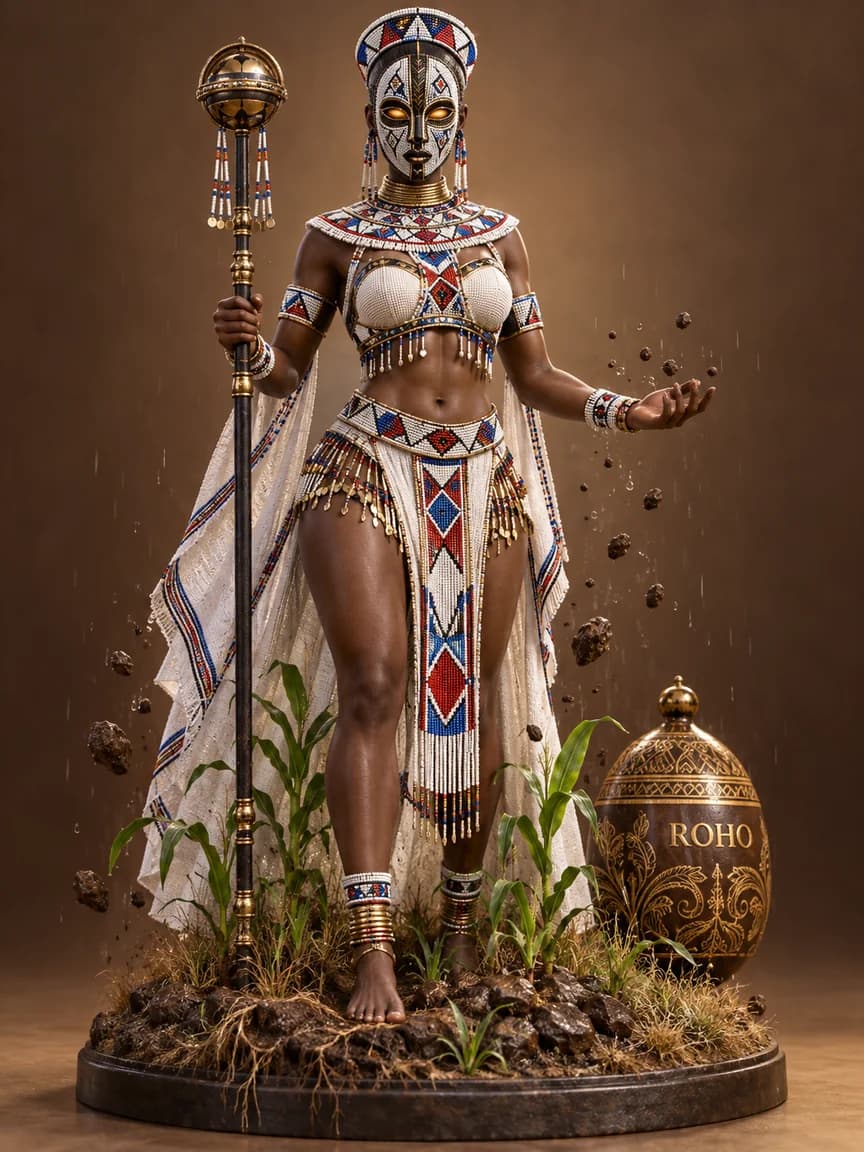
Inkosazana
allyGoddess
Inkosazana, in Zulu iNkosazana yezulu, the princess of the sky, is one of the great feminine figures of the Zulu religion, more widely known under the name of Nomkhubulwana. The ethnographers of the twentieth century, from Eileen Krige to Axel-Ivar Berglund, describe her as a celestial virgin who shows herself in spring, veiled in mist or fine rain, and whose passage makes the fields turn green. She presides over the fertility of the crops, watches over young girls and conveys messages to the diviners. Her traditional cult presents a remarkable trait: it belongs to women. In spring, the young girls cultivated a field for her set apart and brewed beer; during certain rites, they put on men's clothes and drove the cattle. Max Gluckman analysed these ceremonies as rituals of inversion in which the social order is suspended for a time. Berglund reports that she also appears in dreams and near stretches of water, certain narratives lending her the form of a fish woman, and that one avoids looking her in the face. Her rites, fallen dormant over the course of the twentieth century, are enjoying a revival in KwaZulu-Natal, where ceremonies in her honour have been relaunched to accompany the protection of young girls. Inkosazana thus remains a living figure of Zulu spirituality.
Powers & Attributes
Role in the ROHO universe
Mother of the soil. INKOSAZANA holds the fertility of the earth and blesses wombs and seeds. Bound to the Zulu pantheon.
Sacred Mask
An ancient ritual mask of fired clay, bronze and fossilised roots, engraved with symbols of agriculture, embodiment of the power of Inkosazana
Era
Ancient cycle
Frequently asked questions
Who is Inkosazana in the Zulu religion?
Inkosazana, the princess of the sky, is a feminine figure of the Zulu religion associated with the spring rain, the fertility of the fields and the protection of young girls. The ethnographers describe her veiled in mist or fine rain; certain narratives lend her the form of a fish woman near stretches of water. She is more widely known under the name of Nomkhubulwana.
Which rites honour Inkosazana?
Her traditional rites belong to women. In spring, the young girls cultivated a field for her set apart and brewed beer; during certain ceremonies, they put on men's clothes and drove the cattle. The anthropologist Max Gluckman analysed these practices as rituals of inversion. Ceremonies in her honour have been relaunched in KwaZulu-Natal to accompany the protection of young girls.
Do Inkosazana and Nomkhubulwana designate the same figure?
In the classic ethnographies, such as those of Eileen Krige and Axel-Ivar Berglund, iNkosazana yezulu and Nomkhubulwana designate the same celestial princess of rain and fertility. Certain contemporary presentations nevertheless make them two distinct figures, one watching over the growth of the crops, the other over the harvest. The oral tradition, living and plural, allows these variations.
Related spirits
Further reading
Sources and references
- Axel-Ivar Berglund, Zulu Thought-Patterns and Symbolism (1976)
- Max Gluckman, Rituals of Rebellion in South-East Africa (1954)
- Eileen Jensen Krige, The Social System of the Zulus (1936)