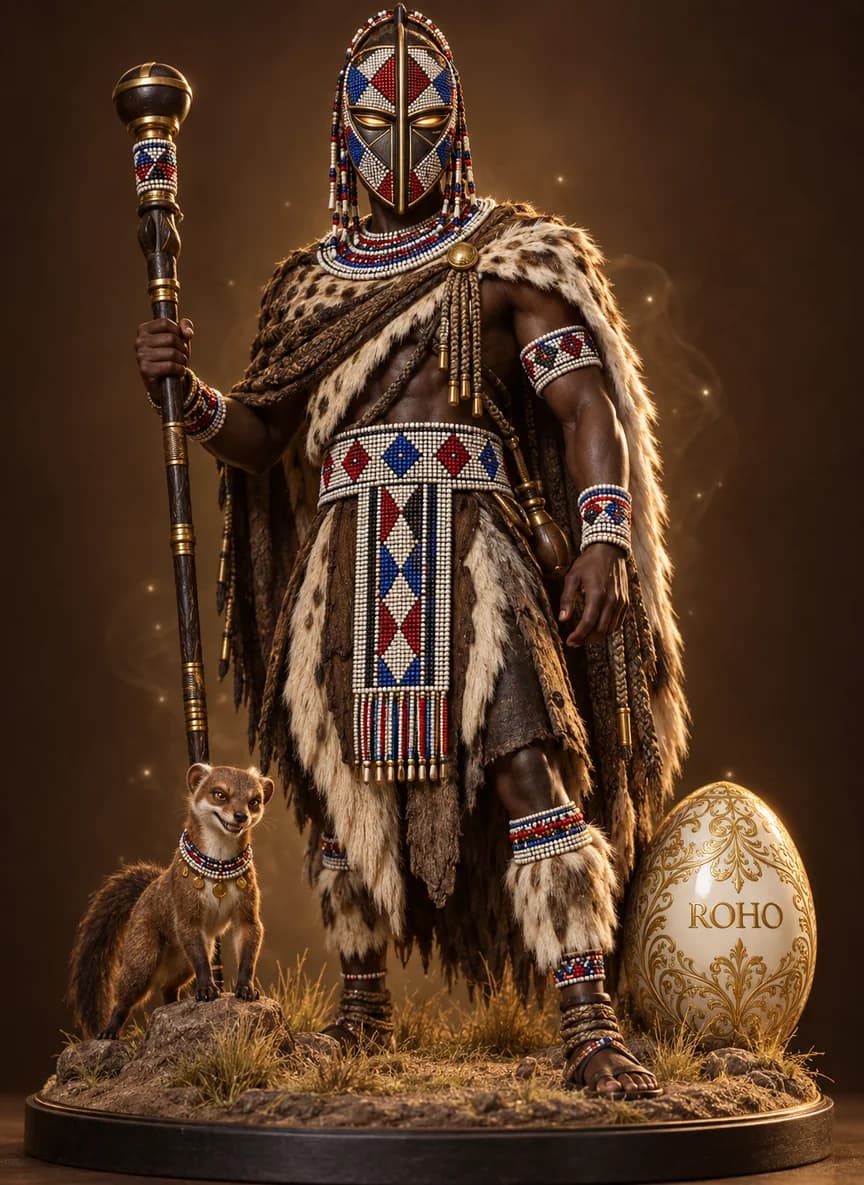
Hlakanyana
allyTrickster, childhood morality / Uhlakanyana
Hlakanyana, in Zulu Uhlakanyana, is a trickster figure of the oral traditions of the Zulu and the Xhosa of South Africa. His name evokes the little cunning one, the little deceiver. He is represented as a tiny being, the size of a weasel, which also earns him the name Ucakijana, the little weasel, endowed with precocious intelligence and unscrupulous cunning. The tales show him speaking before his own birth, then multiplying deceptions and wicked tricks, most often to obtain food. Some versions credit him with the power to change shape. In Zulu tradition his deeds are frankly malevolent, while Xhosa tradition sometimes presents him as an ambiguous being, neither good nor bad but capable of great cruelty. Killed several times over in the narratives, he always returns. Often compared to the tricksters of folktales the world over, Hlakanyana belongs less to mythology than to the moral tale: by violating every social rule, he serves as a mirror to the failings of the community. These stories were collected as early as the nineteenth century by the missionary Henry Callaway.
Powers & Attributes
Role in the ROHO universe
A fragment of Onionkupón's Breath, bound to one of the five elements of the cosmic balance.
Sacred Mask
A mask carved of ancient energy: a symbol of the cosmic force proper to its pantheon.
Era
3,000 to 1,000 BCE: Cycle of Elemental Powers
Spiritual Lesson
To understand the nature of one's own balance and the wisdom hidden behind every trial.
Words of the Spirit
“The spirit crosses what the body cannot.”
Frequently asked questions
Who is Hlakanyana?
Hlakanyana, or Uhlakanyana, is a famous trickster of the Zulu and Xhosa tales of South Africa. His name means the little cunning one. Described as a tiny being, the size of a weasel, he uses his intelligence and cunning to deceive humans and animals, most often in order to feed himself.
Why is Hlakanyana also called Ucakijana?
Ucakijana means the little weasel. The nickname refers to his very small size and his quickness. In the narratives, Hlakanyana speaks before he is even born and proves more cunning than the adults, making him a figure of the precocious child as much as of the deceiver.
What is the function of these tales?
The stories of Hlakanyana do not celebrate the character; they use him as a mirror. By joyfully violating every social norm, the trickster reveals the community's weaknesses. These narratives, collected from the nineteenth century onward, belong to the moral tale more than to mythology properly speaking.
Related spirits
Further reading
Sources and references
- Henry Callaway, Nursery Tales, Traditions, and Histories of the Zulus (1868)
- Alice Werner, Myths and Legends of the Bantu (1933)