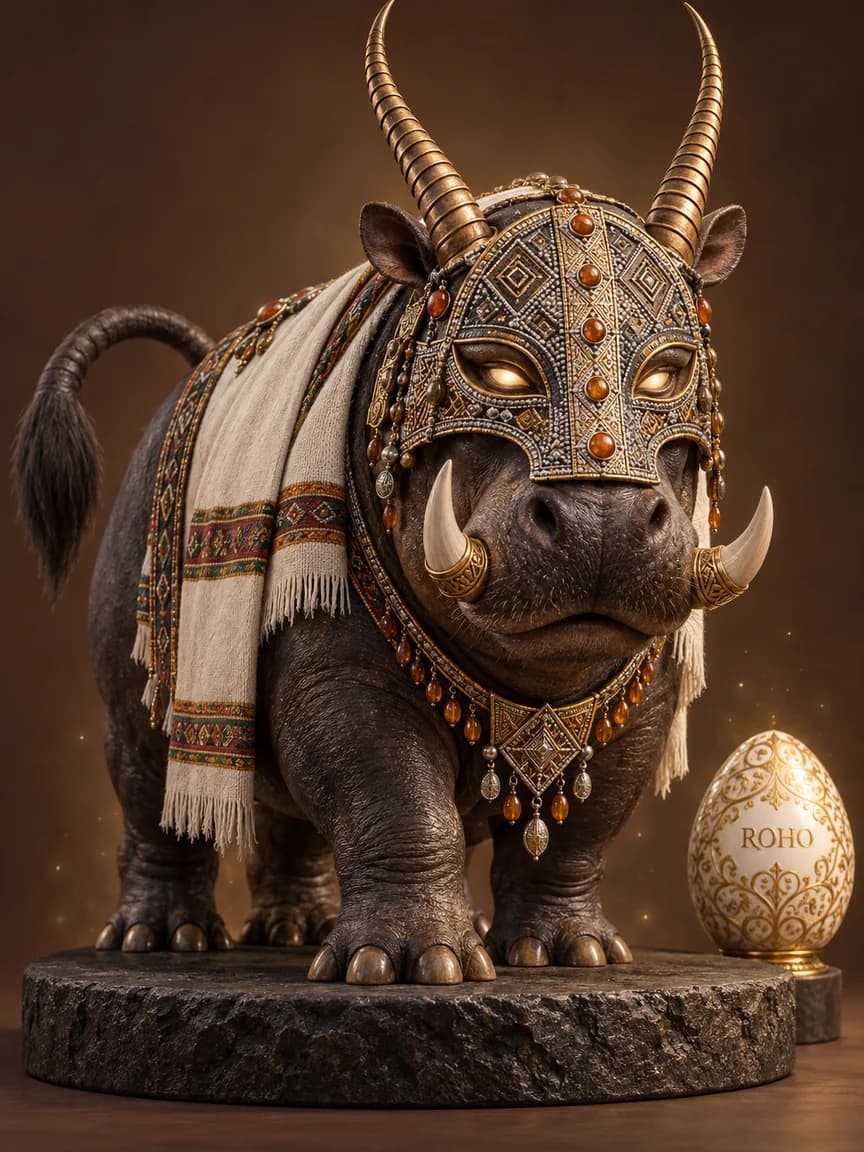
Eale
neutralMonster
The eale, also called yale or centicore, is a legendary creature first described by Pliny the Elder in his Natural History. He places it in Ethiopia and credits it with the size of a hippopotamus, a black or tawny coat, an elephant's tail and a boar's jaws. Its most singular trait is the pair of horns, more than a cubit long, that it can turn at will: mobile, they rise or lower in turn in combat, one serving for attack while the other rests. Later authors, such as Solinus, sometimes moved its origin to India, and the medieval bestiaries made its appearance evolve, between the look of an antelope, a horse, and boar's tusks. The creature enjoyed a long heraldic afterlife in England, notably as a badge of the Beaufort family and a supporter of the arms of John of Lancaster, Duke of Bedford. The name eale is thought, by some hypotheses, to derive from a word meaning ibex.
Powers & Attributes
Role in the ROHO universe
Voice of its pantheon. EALE carries the memory of its tradition and weaves a thread into the Mabioni. Bound to the Ethiopian pantheon. Its alignment depends on the invoker's protocol.
Sacred Mask
An ancient ritual mask of sacred wood, old metal and black stone, engraved with symbols of horns, embodiment of the power of Eale
Era
Ancient cycle
Frequently asked questions
What makes the eale unique?
Its mobile horns, more than a cubit long, which it can turn in every direction and use in turn in combat, one attacking while the other rests.
Who first described the eale?
Pliny the Elder, in his Natural History, who places it in Ethiopia. Later authors such as Solinus sometimes placed its origin in India.
Where is the eale found today?
Above all in English heraldry, where it serves as an emblem of the Beaufort family and a supporter of the arms of the Duke of Bedford, a symbol of proud defence.
Related spirits
Further reading
Sources and references
- Pline l'Ancien, Histoire naturelle, livre VIII
- Wilma George, The Yale, Journal of the Warburg and Courtauld Institutes, vol. 31, p. 423-428 (1968)