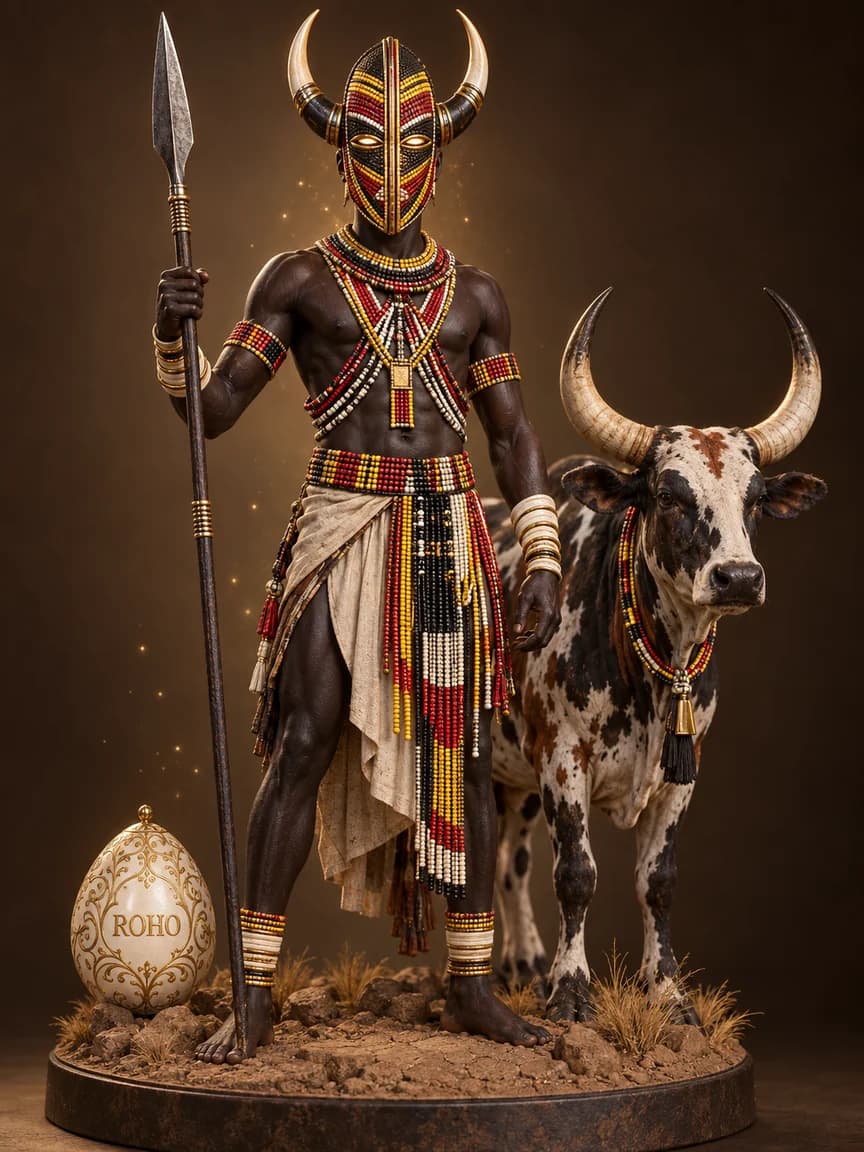
Longar
neutralAnimal/Hero
Longar, more precisely Aiwel Longar, also called Ayuel, is the cultural hero and the founding ancestor of the priesthood of the masters of the fishing spear among the Dinka of South Sudan. Tradition says he was born of the union of a woman and a spirit of the river waters. Endowed with powers from birth, able to move and speak very early, he is said to have lived for a time with his father in the river, then to have returned to the village with an ox of many-coloured coat which he named Longar. According to the Dinka custom that gives a man the name of his ox's characteristics, he was called Aiwel Longar. He distributed fishing spears to the first men who crossed the river and thus founded the clans of the masters of the fishing spear, priests who link humans to the deities and preside over the cattle sacrifices. Aiwel Longar embodies many values of the Dinka tradition, to the point of serving as a measure of human qualities. A site, the pyramid of Pwom Ayuel, is associated with him as his supposed burial place.
Powers & Attributes
Role in the ROHO universe
Voice of its pantheon. LONGAR carries the memory of its tradition and weaves a thread into the Mabioni. Bound to the Dinka pantheon. Its alignment depends on the invoker's protocol.
Sacred Mask
An ancient ritual mask of sacred wood, old metal and black stone, engraved with symbols of sacred ox, embodiment of the power of Longar
Era
Ancient cycle
Frequently asked questions
Who is Aiwel Longar?
He is a hero and ancestor of the Dinka tradition, reputed to be the son of a river spirit. He founded the priesthood of the masters of the fishing spear, priests who make the link between humans and the deities.
Where does the name Longar come from?
Longar was the name of the many-coloured ox brought back by the hero. According to the Dinka custom that names a man after his ox, he was called Aiwel Longar.
What is the role of the masters of the fishing spear?
Descendants of Aiwel Longar, the masters of the fishing spear are priests. They link the community to the deities and preside over the cattle sacrifices in Dinka ritual.
Related spirits
Further reading
Sources and references
- Godfrey Lienhardt, Divinity and Experience: The Religion of the Dinka, Oxford University Press, 1961
- Francis Mading Deng, Dinka Cosmology (1980)
- Charles Gabriel Seligman et Brenda Z. Seligman, Pagan Tribes of the Nilotic Sudan (1932)