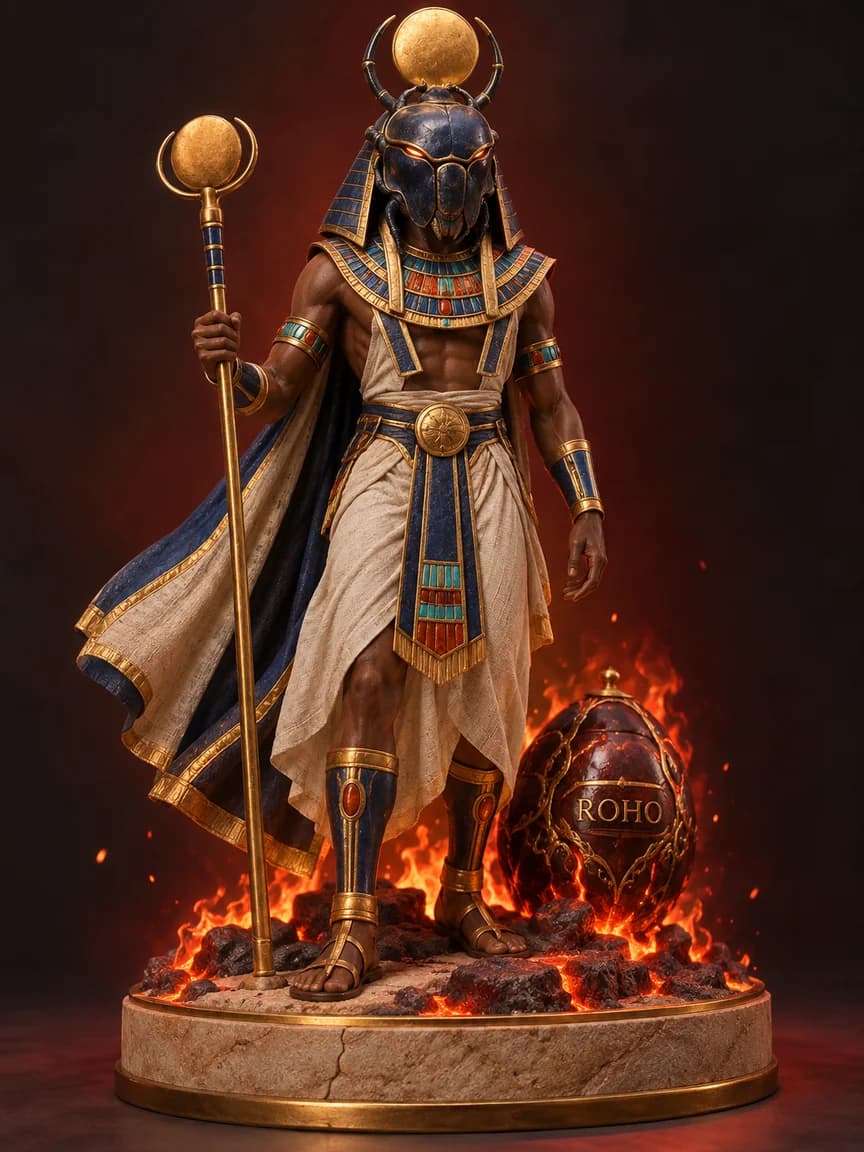
Khepri
neutralScarab god of the rising sun
Khepri is a solar deity of ancient Egypt, the figure of the morning sun and of perpetual renewal. His name derives from the verb kheper, to come about or to come into existence, and associates him with the idea of self-creation. The Egyptians assimilated him to the dung beetle, which rolls its ball as the god pushes the solar disc above the horizon, and which they believed was born spontaneously from matter. He is represented in the form of a scarab, of a man with a scarab's head, or of a scarab surmounting the solar disc. In the Heliopolitan theology, Khepri embodies the first phase of the sun's daily journey: he becomes Ra at noon, then Atum at sunset. This solar triad expresses the god's course across the sky and his regeneration at dawn, after the nocturnal crossing. A symbol of immortality and resurrection, the scarab of Khepri was one of the most widespread motifs of the Egyptian funerary amulet, notably the heart scarab placed on mummies. He is closely bound to the great solar sanctuary of Heliopolis.
Era
3,000 to 30 BCE
Frequently asked questions
Why a scarab to represent the sun?
The dung beetle rolls its ball before it, an image of the solar disc pushed across the sky. The Egyptians believed it was born spontaneously, a perfect symbol of self-creation and rebirth.
What is the difference between Khepri, Ra and Atum?
They embody the three moments of the sun: Khepri at its rising, Ra at its zenith, Atum at its setting. Together they describe the star's daily cycle.
What does the heart scarab mean?
It is an amulet in the form of a scarab placed on the mummy, at the level of the heart, invoking Khepri to ensure regeneration and the passage to eternal life.
Related spirits
Further reading
Sources and references
- Richard H. Wilkinson, The Complete Gods and Goddesses of Ancient Egypt (2003)
- Erik Hornung, Conceptions of God in Ancient Egypt: The One and the Many (1982)
- , Wikipedia (FR/EN)